Any five of the 13 Obelisks
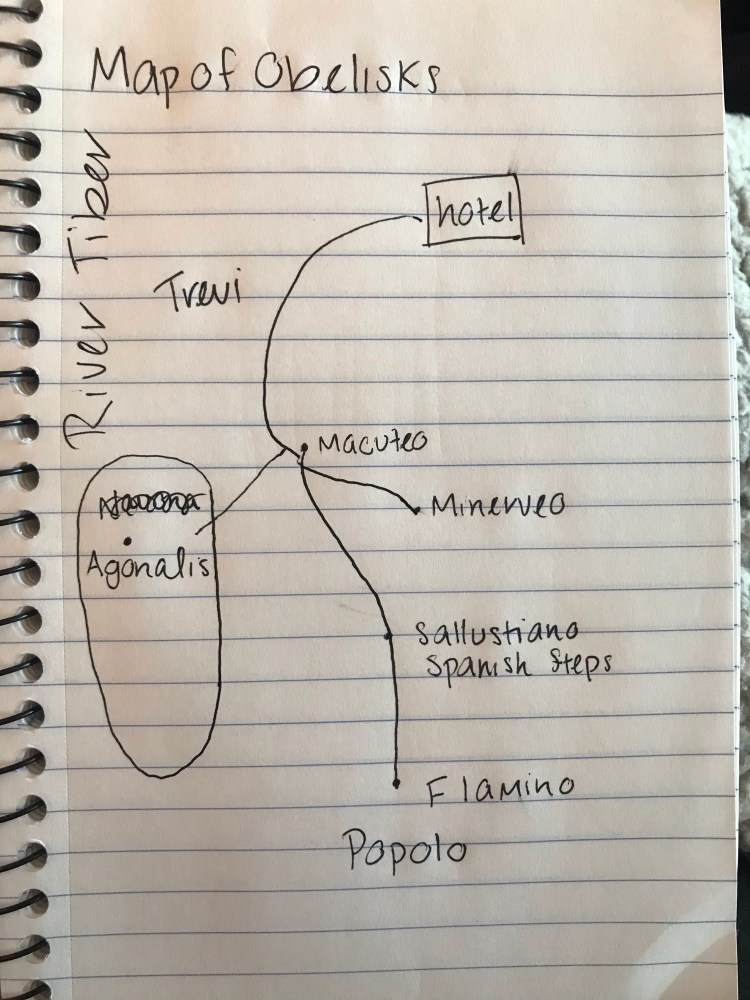
Describe their setting and provide information of where each one came from, who brought it here, and when it was placed where it is now. Take a photo for your blog. Draw a map (you can use google if you want—or just a rough hand drawing) orienting them to each other and a few landmarks (monuments, hotel, bars, etc.).
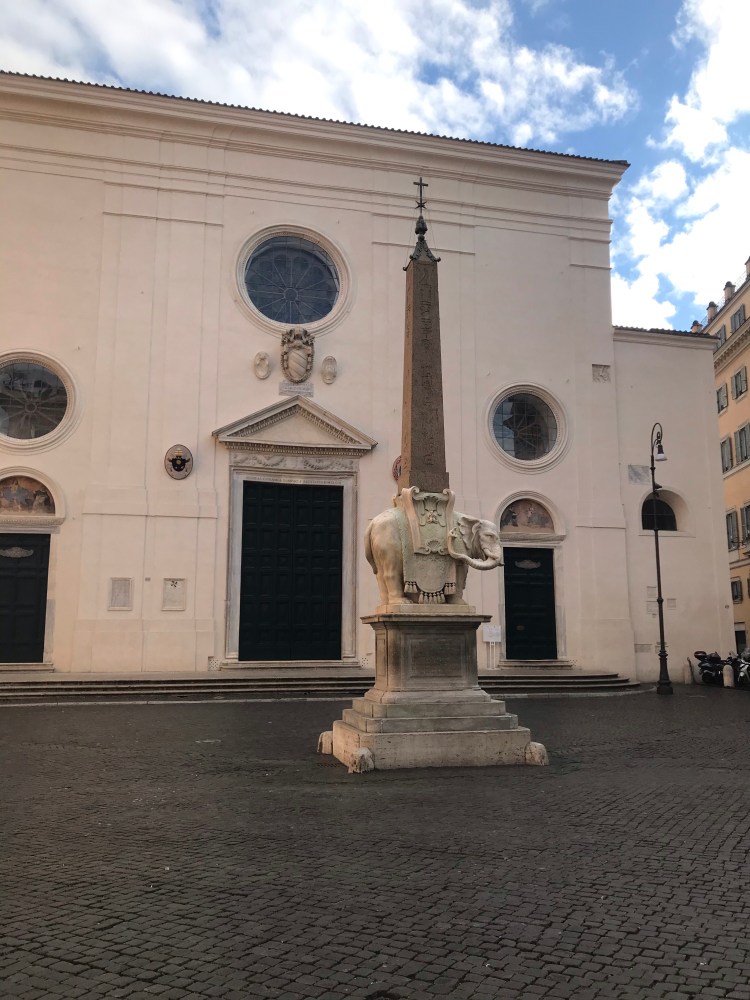
The Minerveo was brought from the ancient Egyptian town of Sais. It was brought by Diocletian and erected where it is now standing in 1667. It was placed on top of the elephant that was made by Bernini. This was my favorite obelisk that we saw. It is currently in front of the Santa Maria Sopra Minerva.
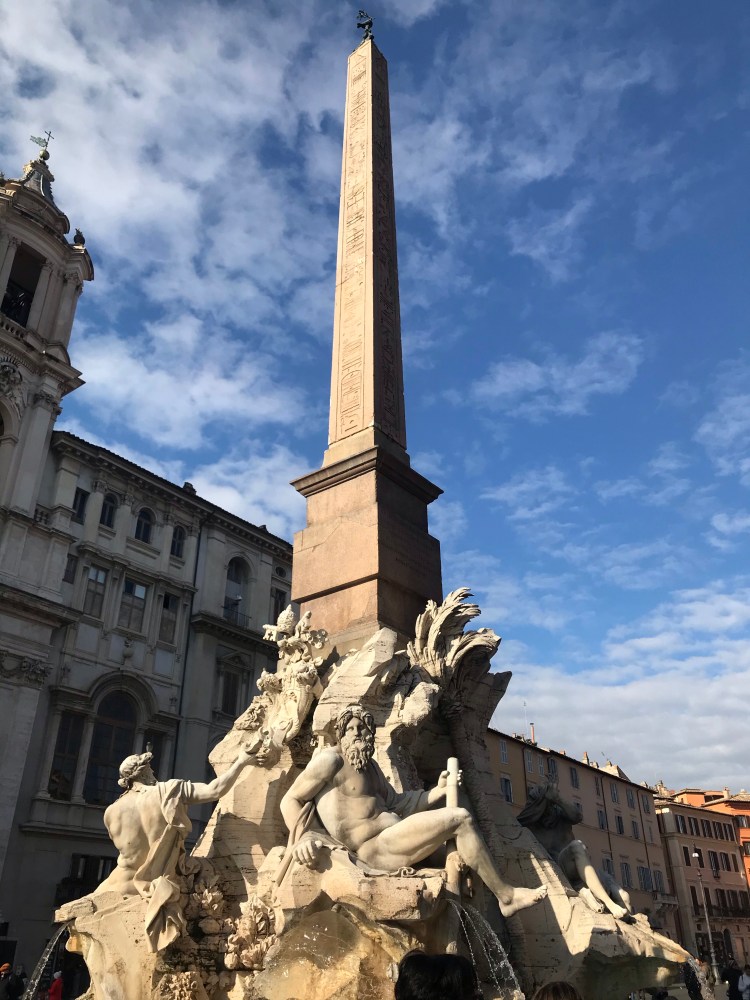
The Agonalis obelisk is placed in the Piazza Navona is erected on top of the Fontana dei Quattro Fiumi. The obelisk was moved here by Bernini in 1651 after having been at the Circus of Maxentius and at the Temple of Serapis before that. This obelisk was commissioned by the Emperor Domitian as an imitation of the Egyptian ones.
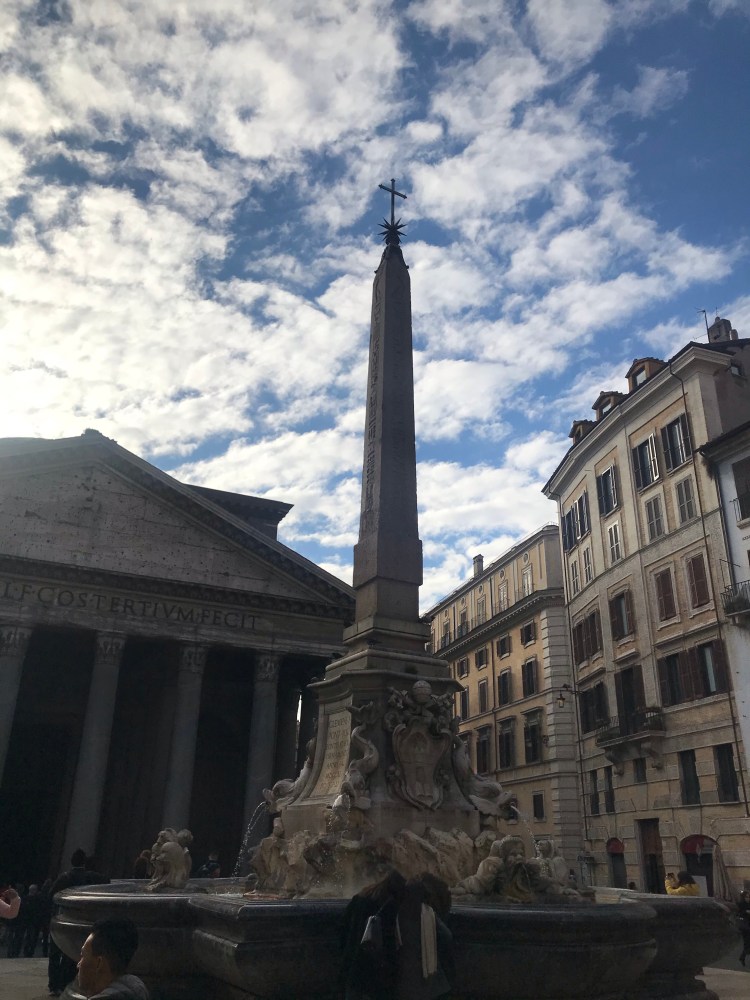
The Macuteo currently sits in front of the Pantheon on top of a fountain. This was originally one of a pair at the Temple of Ra in Heliopolis, a major city of ancient Egypt. It was moved to where it is now by Pope Clement XI in 1711.
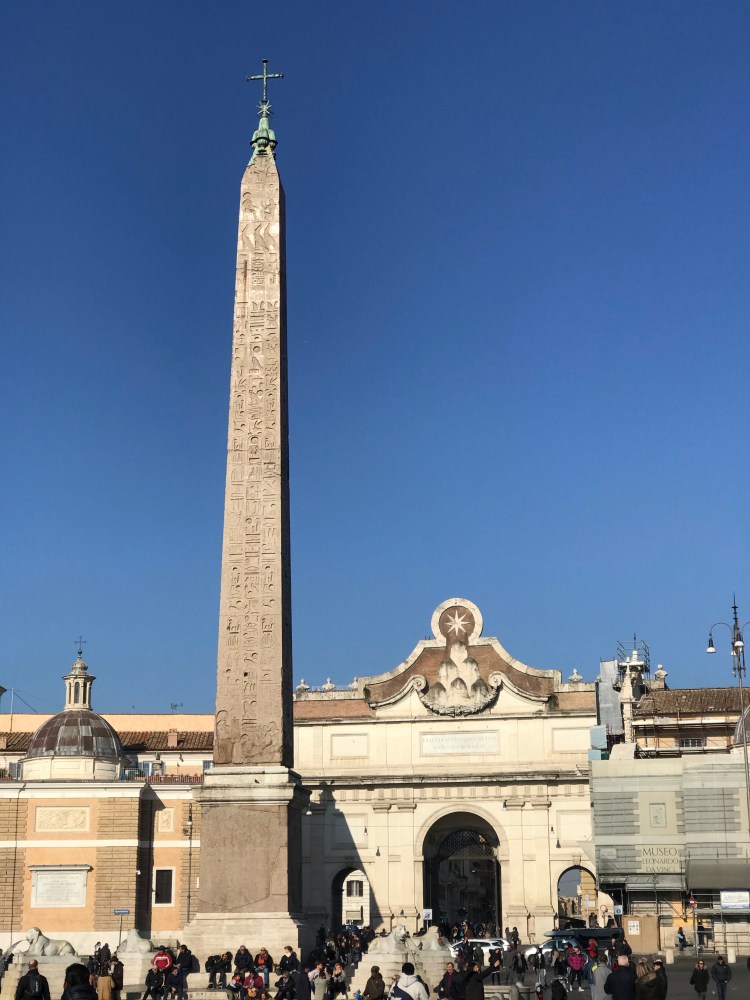
The Flaminio was brought by Augustus in 10 BC. It was originally from the ancient Egyptian city of Heliopolis. It now sits in the Piazza del Popolo after being placed there in 1589.
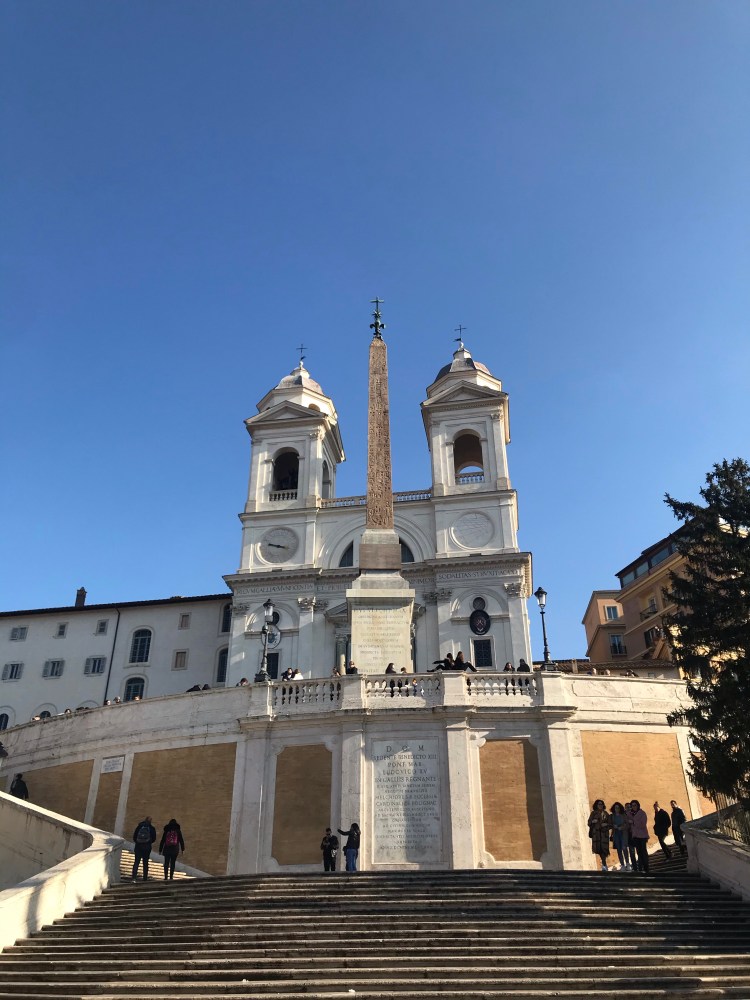
The Sallustiano is a copy of the Flaminio that sits in the Piazza del Popolo. It was found and placed near the Spanish Steps in 1734. It was found by Ludovisi.
Pantheon
Video yourself pacing the number of steps from the door to the center. How many ‘steps’ tall is the oculus of the dome?
It took me 72 steps to walk from the center of the building to the door. Seeing that this would be considered the radius of the sphere, 144 steps would be the radius of the sphere. This means that the dome is 144 steps tall.
Find and photograph any six Caravaggio paintings in Rome:
Briefly describe the content of each paintings. Also, what is the most brightly painted object in each of the paintings? Use one (or more) of the Caravaggio paintings that you discovered in Rome to respond to Michael Fried’s account of absorption (in the Soundcloud lecture). Set out Fried’s account and then how the painting does or does not fit his account. Write 500 words.
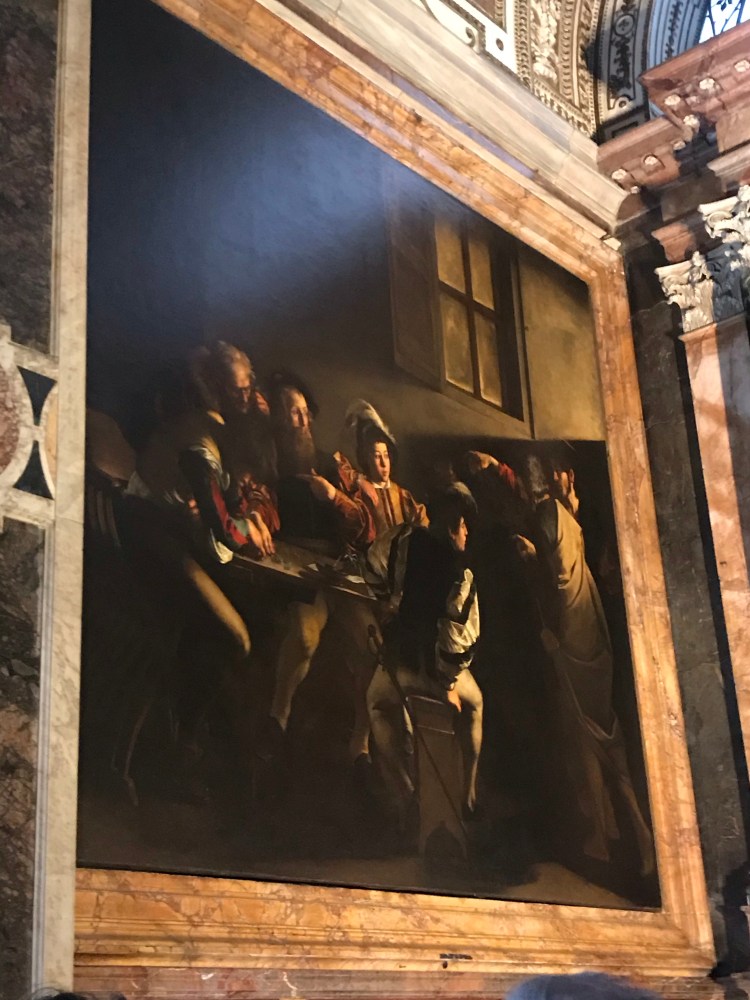
The Calling of St Matthew. This painting by Caravaggio is showing the moment when Jesus is asking Matthew to follow him and inspiring him to become a a disciple. The most brightly lit subject in this painting in the young boy facing us sitting at the end of the table, he is sitting closest to where the light seems to be coming from, maybe a window beyond the right hand side of the painting. There has been recent debate over who might be Matthew in this painting, the bearded man or the boy sitting all the way to the left.
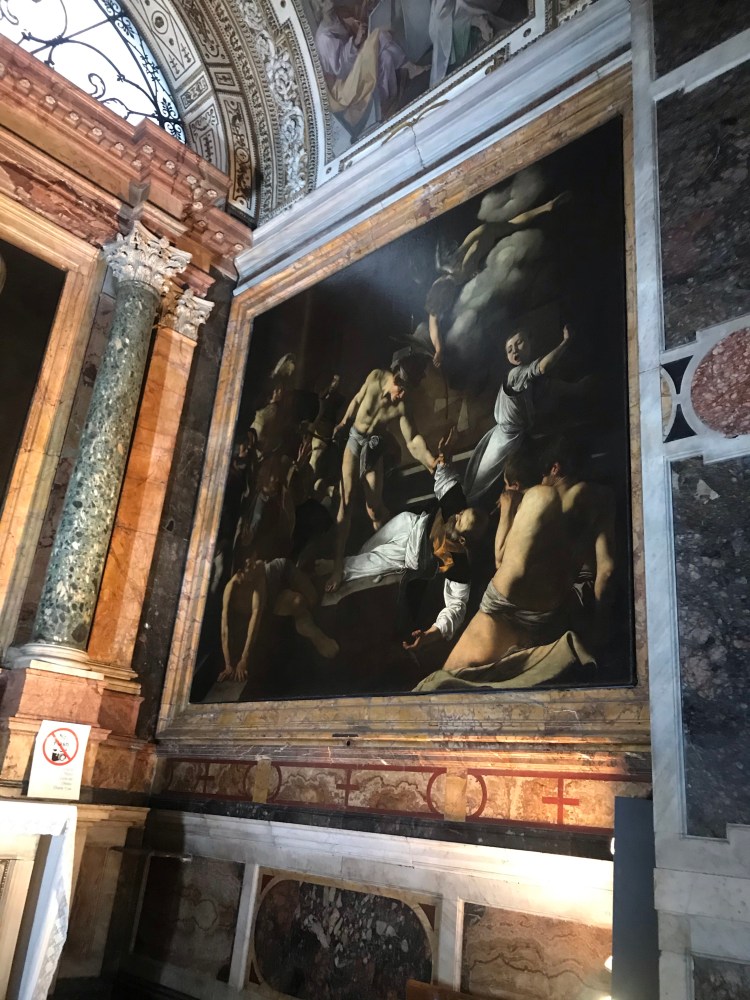
The Martyrdom of Saint Matthew. This painting by Caravaggio is showing the killing of St. Matthew by the king of Ethiopia while celebrating mass. It is showing the most dramatic moment when the saint is about to be killed by a solider of the king. The background of the story is that the king had been highly criticized by Matthew because he was lusting over his niece who was a nun and bride of Christ and should not be lusted over. The most brightly lit in this painting is the solider who is about to kill Matthew.
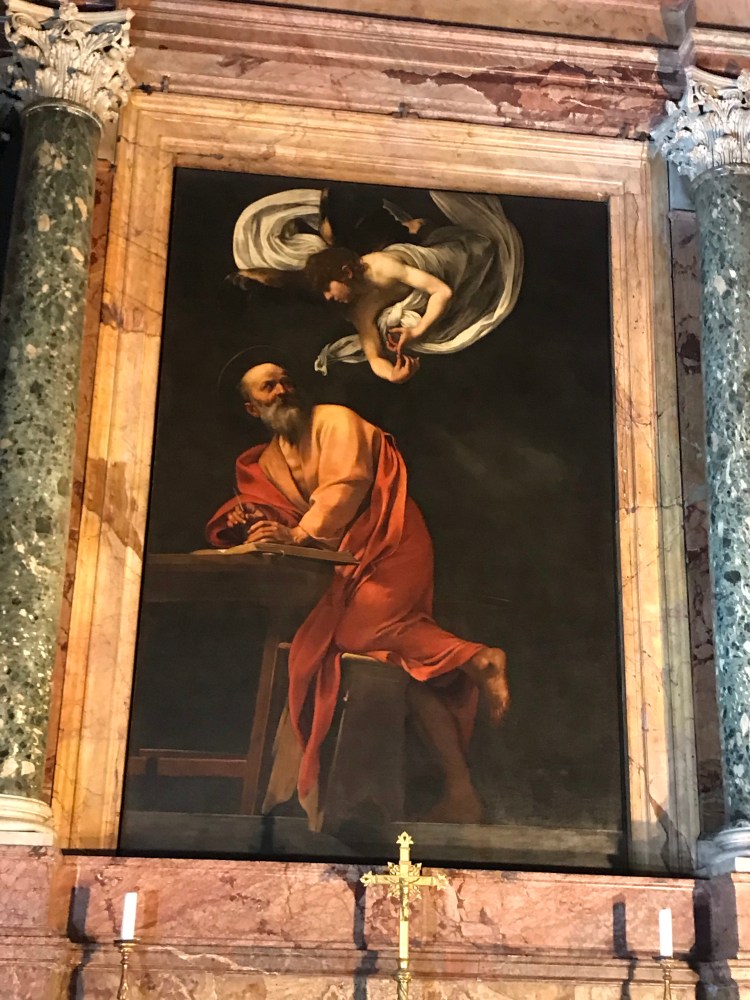
Inspiration of Saint Matthew. This painting by Caravaggio is portraying an angel as a messenger coming to the saint, and it appears that he is telling him a list of things that he needs to do. By having the angel come from above, as opposed to being next to the saint as in the first version of this painting, it appears to be a divine intervention and not just a casual interaction. Saint Matthew is the most brightly lit in this painting.
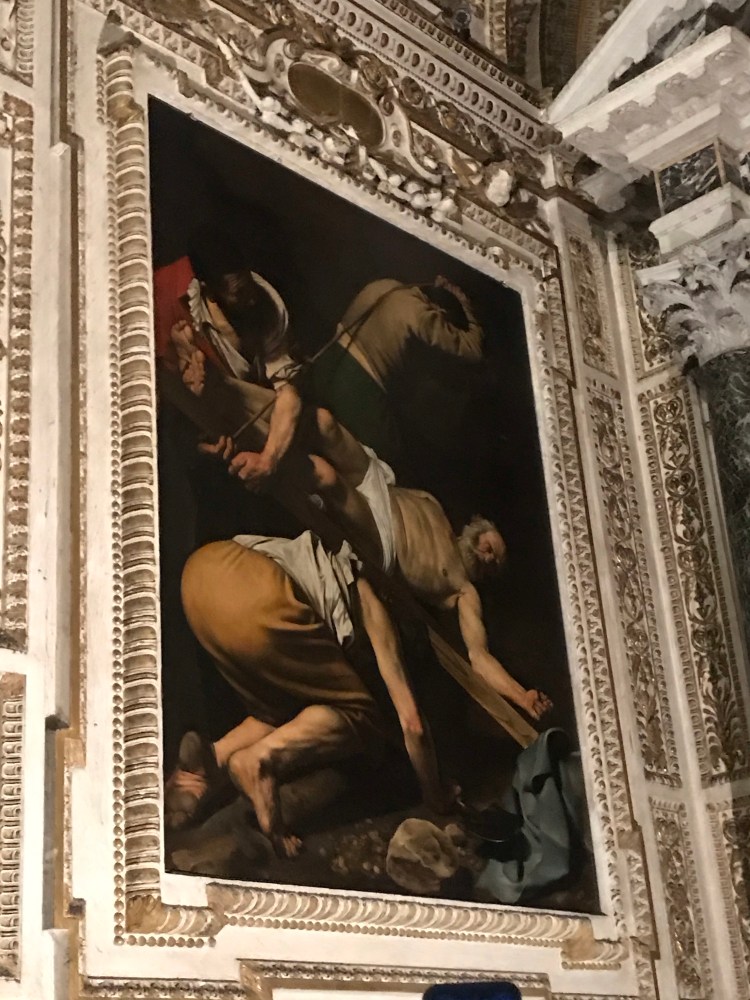
Crucifixion of Saint Peter. This painting by Caravaggio is depicting the killing of Saint Peter. According to the story Peter wanted to be crucified upside down because he didn’t believe that he was worth to die in the same way that Jesus Christ did. In the paining you can see the three men trying to upright to cross while Peters lays there already nailed in. Saint Peter is the most brightly lit object in this painting.
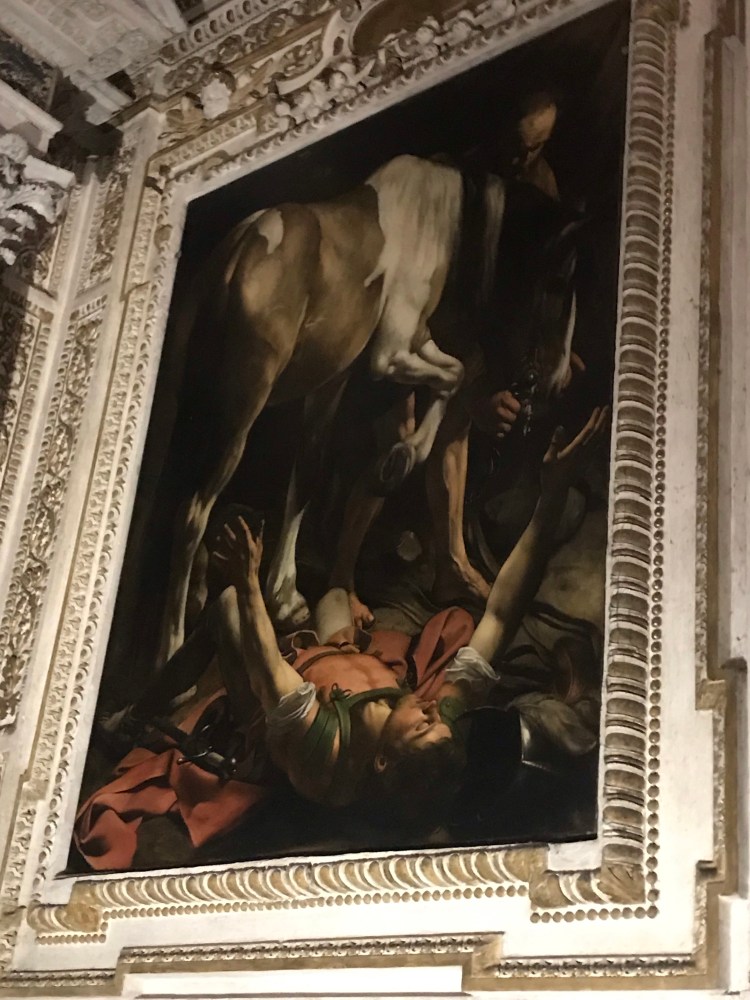
The Conversion on the Way to Damascus. This painting by Caravaggio shows the moment when Paul saw the light of Jesus. The story says that Paul was a prosecutor of Christians and on his way to Damascus he saw the light of Jesus asking him why he prosecuted the people who follow him. This is the moment when Paul fell from his horse because of the blinding light. The most brightly lit in this painting is Saint Paul.
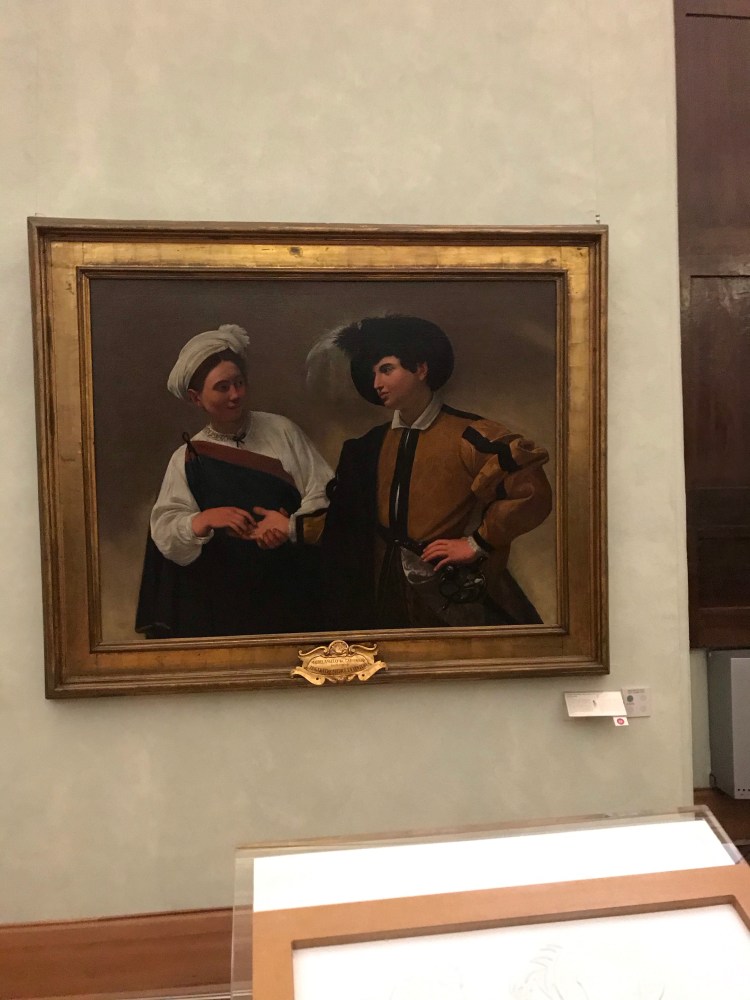
The Fortune Teller. This is the first version of the painting by Caravaggio. The painting shows a well dressed man who seems to be of a high class holding hands with a young girl who seems to be of a lower class. The boy is looking into the girls eyes and he doesn’t notice that she is taking the ring off of his finger. Looking at both versions on the internet, I like this version better than the second one. In this painting the young boy is brighter lit than the young girl.
Michael Fried devolves his account of absorption by using mainly two pf the paintings that are in the Church of San Luigi dei Francesi in Rome. He uses The Martyrdom of Saint Matthew and The Calling of Saint Matthew. With both of these painting Fried describes how Caravaggio is able to portray the subjects f the painting of being on there for a moment. He describes how the light in The Calling of Saint Matthew seems to come from a window outside of the painting. He also shows how in The Calling of Saint Matthew you see that Matthew and Jesus are only there for a moment, they will soon move on to something else. Caravaggio has shown the subjects essentially only in one moment, meaning us as the viewers only see the objects in that moment and they will quickly move on to the next thing. Fried also uses The Martyrdom of Saint Matthew to further the idea of absorption. We, as the viewer, are able to see for a prolonged period only a moment in time. Here Caravaggio is showing the execution of Matthew, Fried describes how there are subjects in the paintings going every which way. Some subjects in the painting have their back faced to us and they are fleeing the seen, others are facing us also feeling the scene.
The Fortune Teller was my favorite Caravaggio that we saw in Rome. Most likely it was my favorite because it was one of the few that we saw that did not depict a religious story, and I am not very religious myself. I think this Caravaggio is a perfect example of absorption, if you accept the story that is told along with the painting. If you are not quite convinced that the gypsy, or young girl, is taking the ring of the boy then you are simply seeing an interaction of the two and it might not be as good of an example of absorption. If you accept that the gypsy is in fact taking the ring from the young boy, then we have a perfect example of absorption. Caravaggio is able to portray the two in a single moment, the gypsy is taking his ring and the boy is taken by her beauty and has not noticed that she is stealing from him. We can assume that past this moment in the painting the boy noticed that she had taken his ring, and the gypsy quickly ran away before she could catch him. We also see that there is something happening outside of this painting. There is a source of light coming from the right hand side of the painting, which you can see because the young boy is brightly lit and he seems to be casting a small shadow on the young girl. Beyond the stealing of the ring, I also think their facials expressions show perfect absorption. The boy in this single moment is taken aback by the beauty of the girl and he seems to be smiling at her, and the young girl is looking him in the eye distracting him long enough to take his ring.
Find where Julius Caesar was assassinated. Video yourself at the location reciting from Cicero’s Philippicae:
“For what greater exploit (I call you to witness, O august Jupiter!) was ever achieved not only in this city, but in all the earth? What more glorious action was ever done? What deed was ever more deservedly recommended to the everlasting recollection of men? Do you, then, shut me up with the other leaders in the partnership in this design, as in the Trojan horse? I have no objection; I even thank you for doing so, with whatever intent you do it. [33] For the deed is so great a one, that I can not compare the unpopularity which you wish to excite against me on account of it, with its real glory.”
September 44 BC — Philippicae (The Fourteen Orations Against Marcus Antonius), Cicero. “Delphi Complete Works of Cicero.” Apple Books.
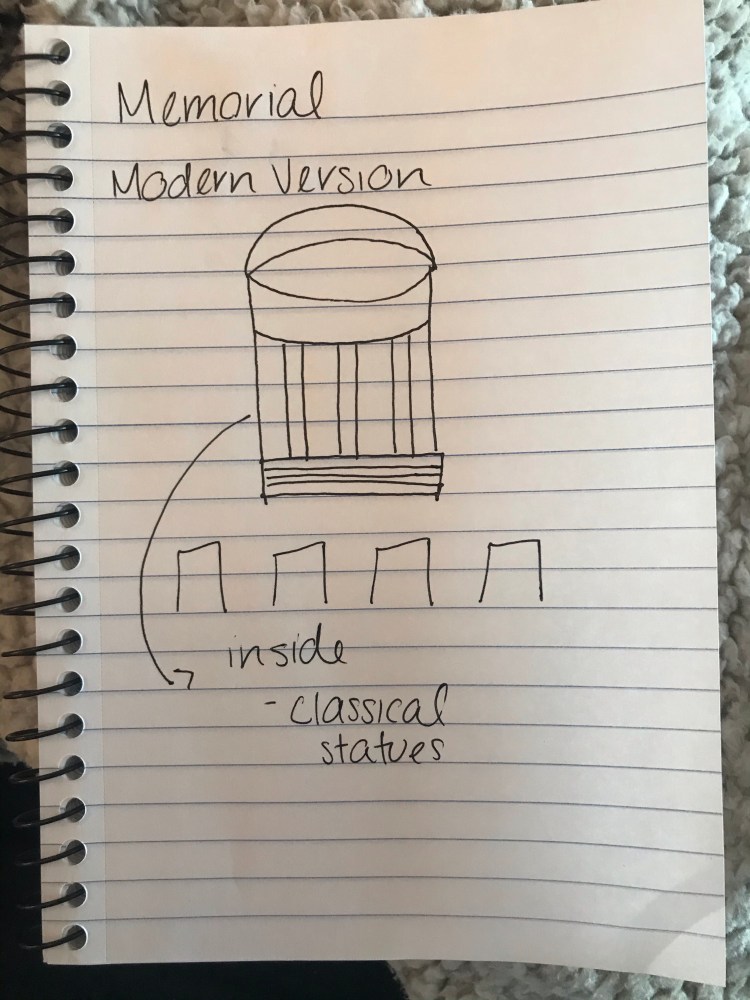
Design a memorial to Brutus and Cassius for the location of the tyrannicide against Caesar. Keep mind the Athenian monuments for Harmodius and Aristogiton, the very first political statues.
If I were to design a memorial to Brutus and Cassius, I would do it much differently today then I would have done it in 44 BC. The classical version of my memorial would be very similar to the Harmodius and Aristogiton monument. I would be the statues of Brutus and Cassius facing each other, most likely naked and standing in a powerful pose. Brutus would be holding a knife and Cassius would be slightly behind him. This is almost a copy of the Harmodius and Aristogiton monument, but it is the style that things were back then. If i were to make this memorial in he modern day I would have a small dome with columns lining the outside. Inside the dome would be the great statues of Brutus and Cassius. And outside of the dome I would have plaques that would have famous sayings and commemorate what had happened there. This would be a little more complicated in the space that is currently at this location, but I would probably but it in the middle of the plaza.

Short video of you at Trajan’s Column describing one feature of the column’s frieze. How many times does the frieze circle the column?
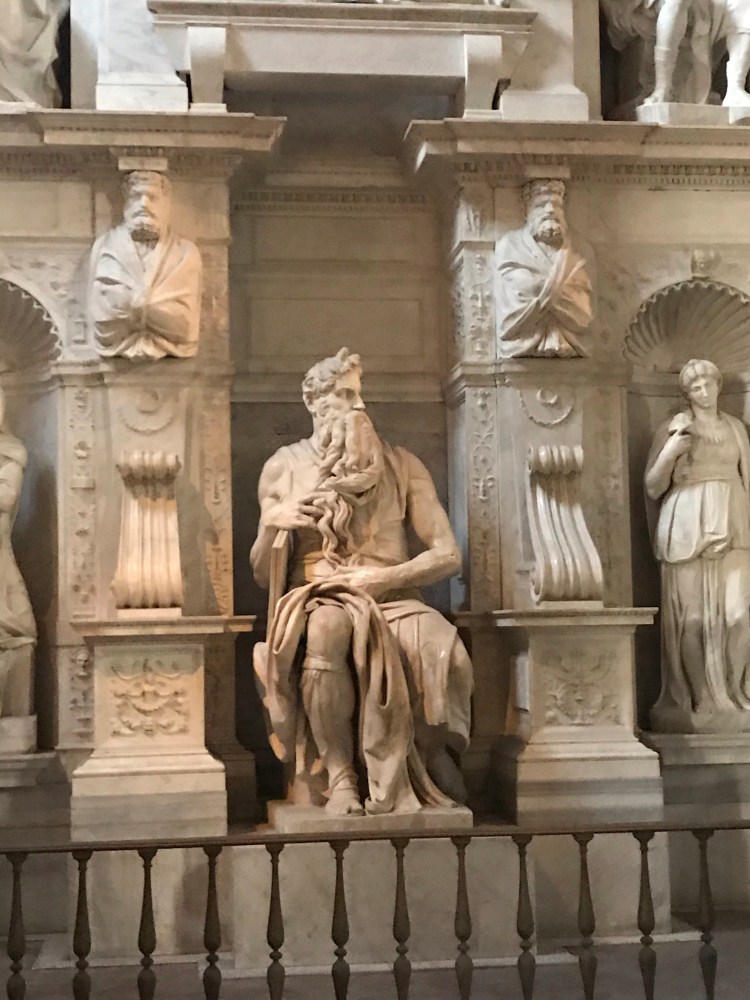
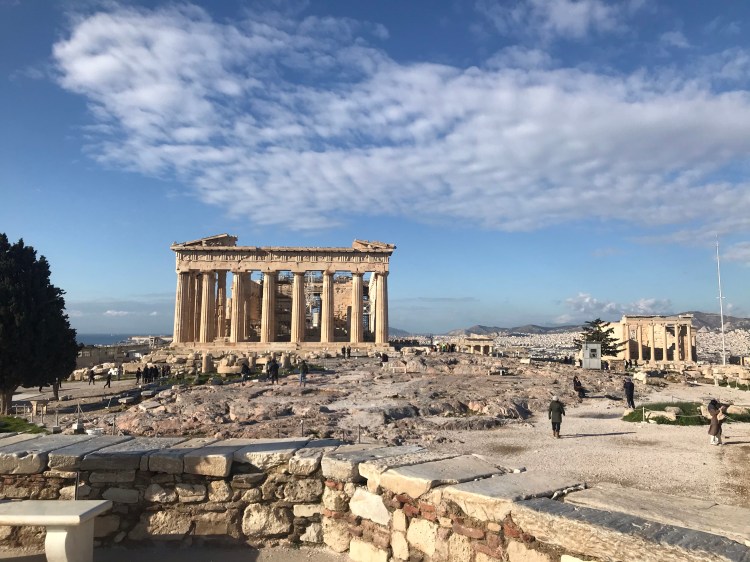
Michelangelo’s Moses: briefly compare Freud’s account of the Acropolis to his account of Michelangelo’s Moses. Pictures of both.
Freud’s account of the Acropolis is very different from his account of Michelangelo’s Moses. In his account of the Acropolis he is writing a letter to a friend and he is more describing the human behavior of the person who is seeing this monument. He goes into depth on how people might feel when they see the monument and how he felt when he saw it. On his account of the Moses, he is more trying to analyze the statue of Moses and what he is thinking at the moment. He also talks a lot about Michelangelo’s intentions when building this monument, and how great pieces of art like this one always rely on the intentions of the artist who make them. In all I think the two accounts are similar that they talk about human emotion attached with monuments, but I think he is talking about two different sides of this human emotions. So to say in the Moses he is talking more about the artist and the subject, but in the Acropolis he is talking more about the viewer.
 Keep up with Veronica abroad