This was hands down the best monument I’ve ever visited. Just thinking about how long the Parthenon has been there and all the culture and monumental events that have happened there is amazing.
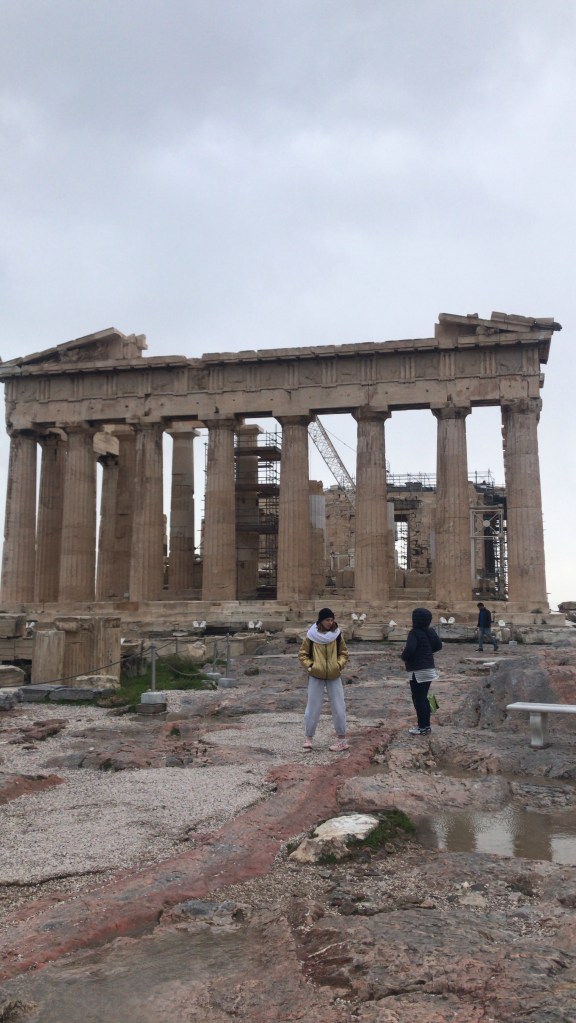
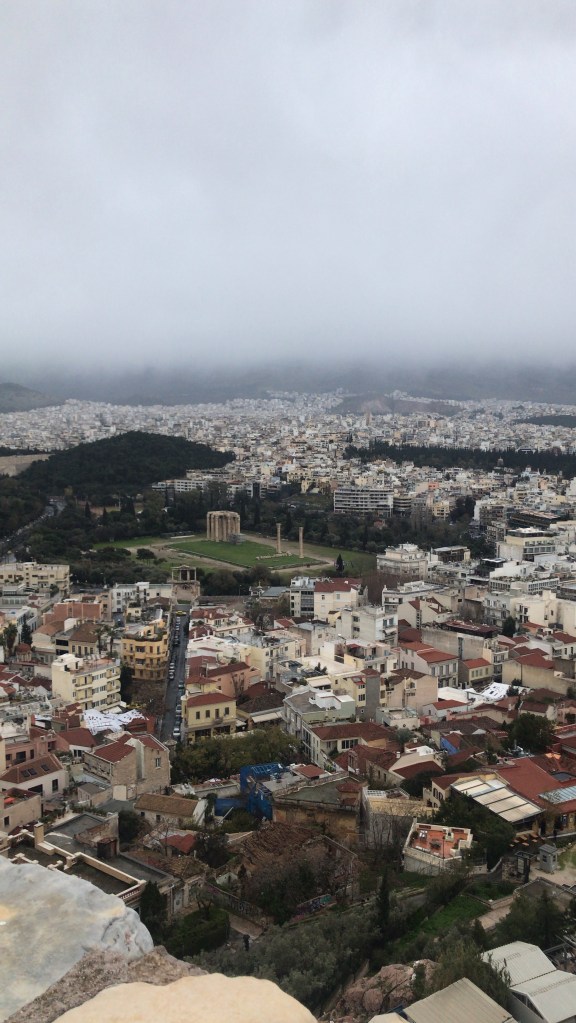
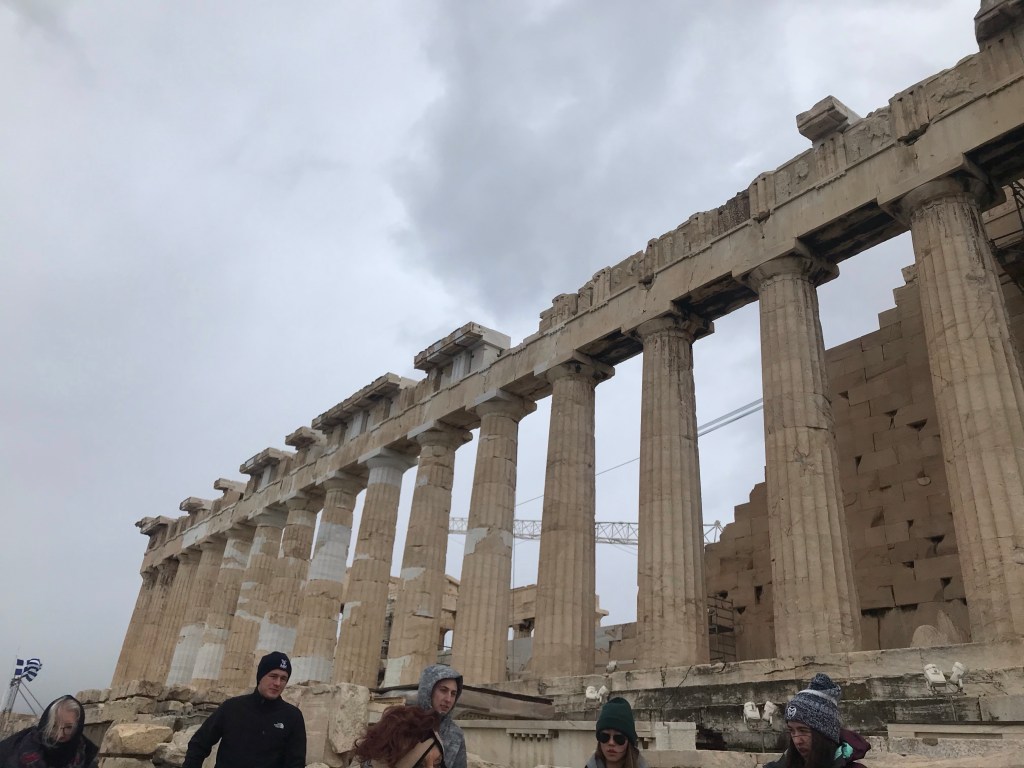
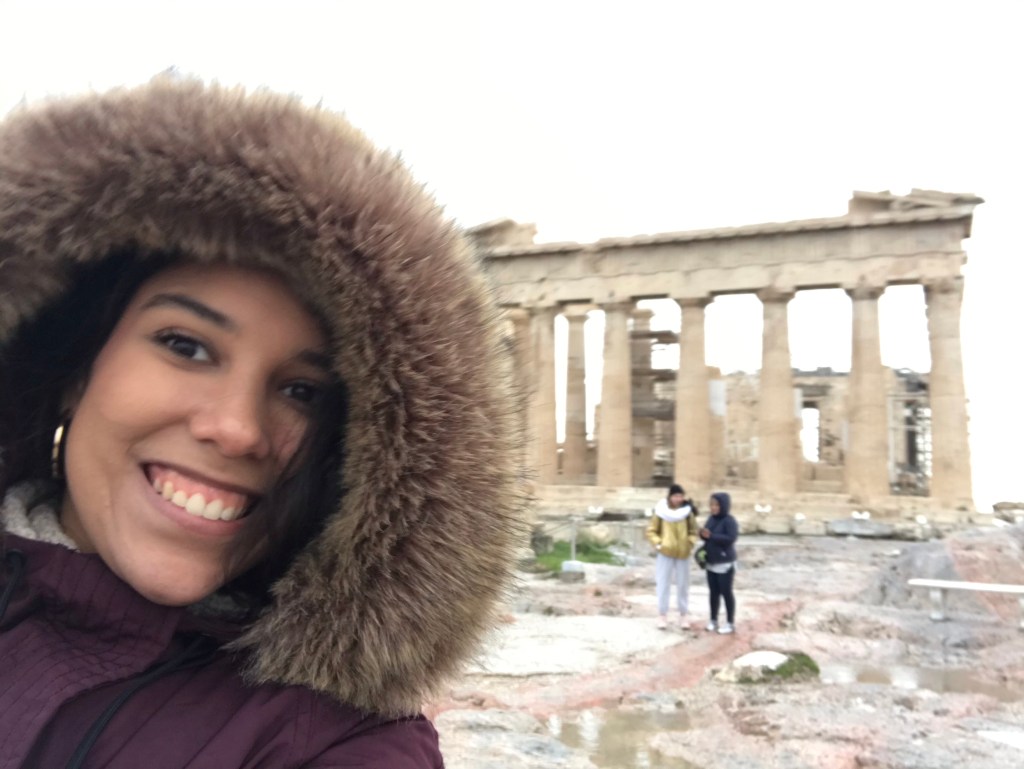
This was hands down the best monument I’ve ever visited. Just thinking about how long the Parthenon has been there and all the culture and monumental events that have happened there is amazing.
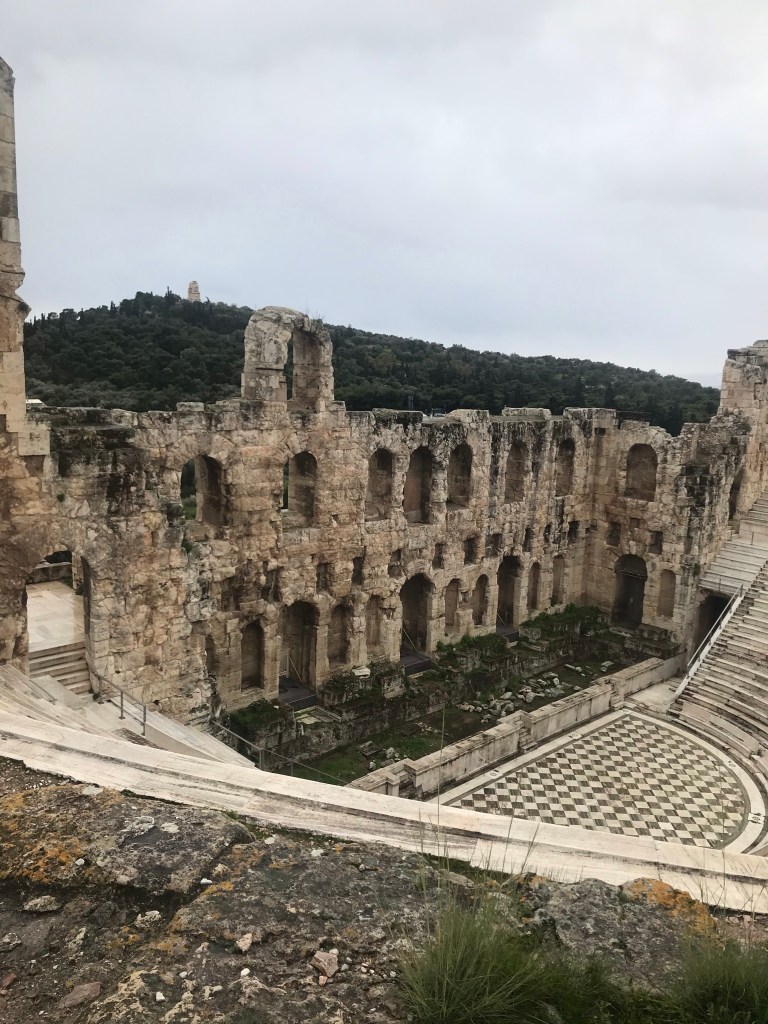
Theater of Dionysus
Film yourself reciting by memory one passage from Euripides, Bacchae on the stage of the Theater of Dionysus. You can also film right outside the fence but it is more fun on the actual stage.
Plaka and Monastiraki
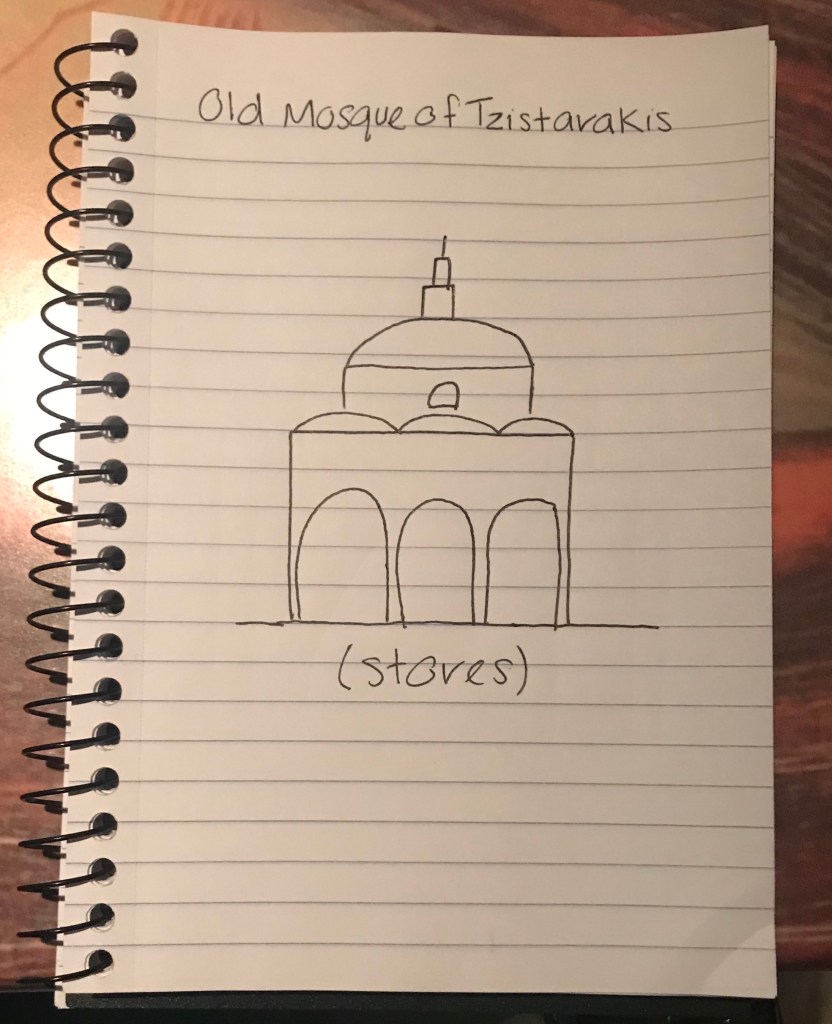
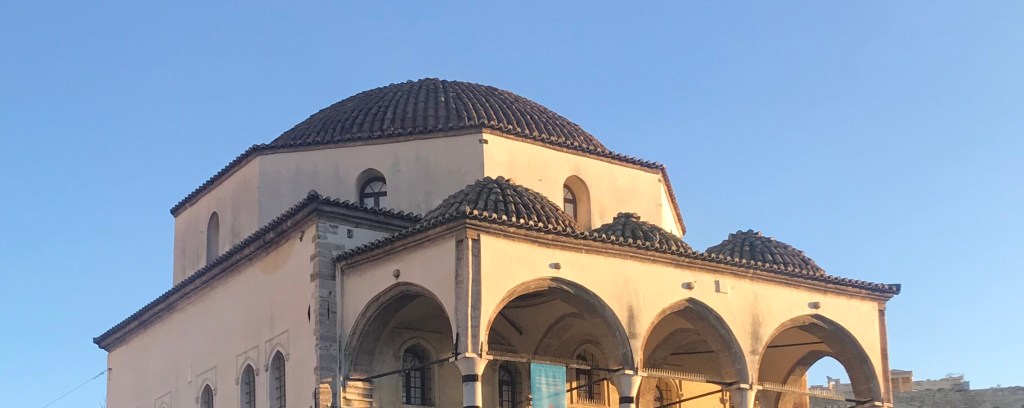
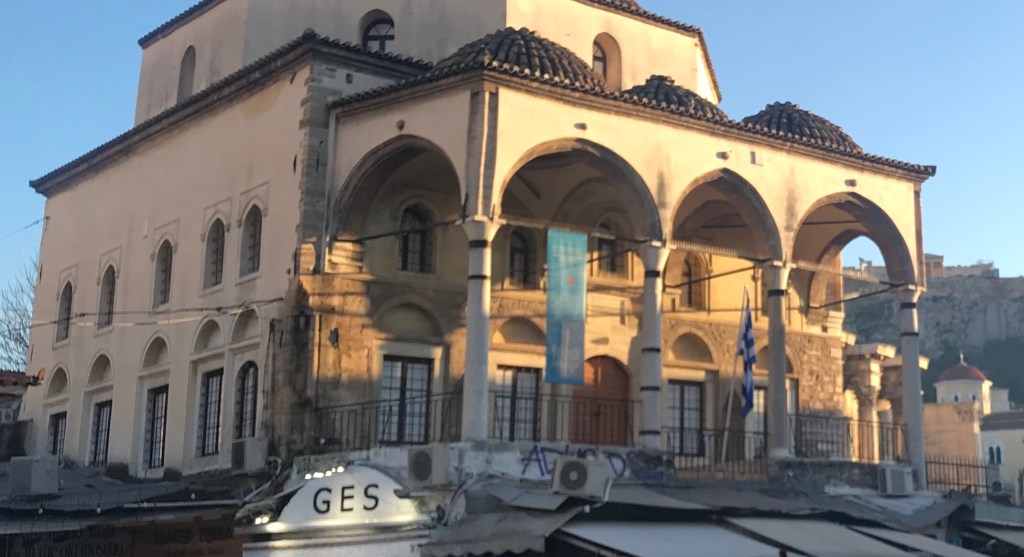
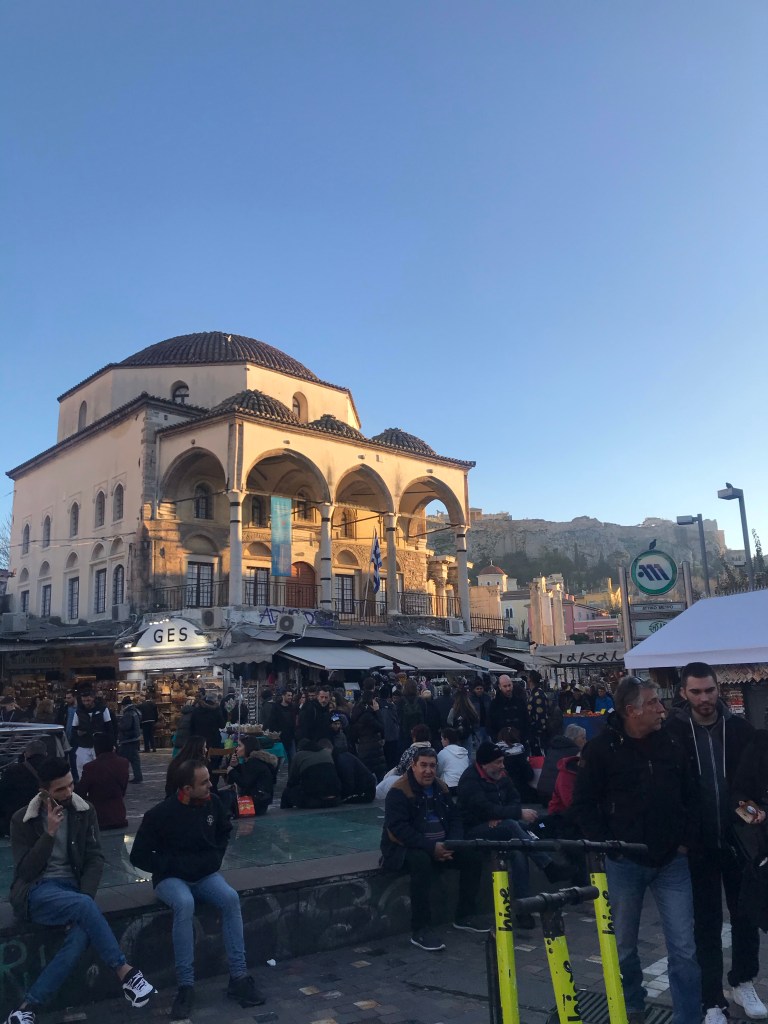
Photograph three interesting features of the old Mosque of Tzistarakis. Draw a version of it with the minaret. Where do you find Arabic writing on the building?
You can find Arabic writing on the mosque above the door in the front.
Tower of the Winds
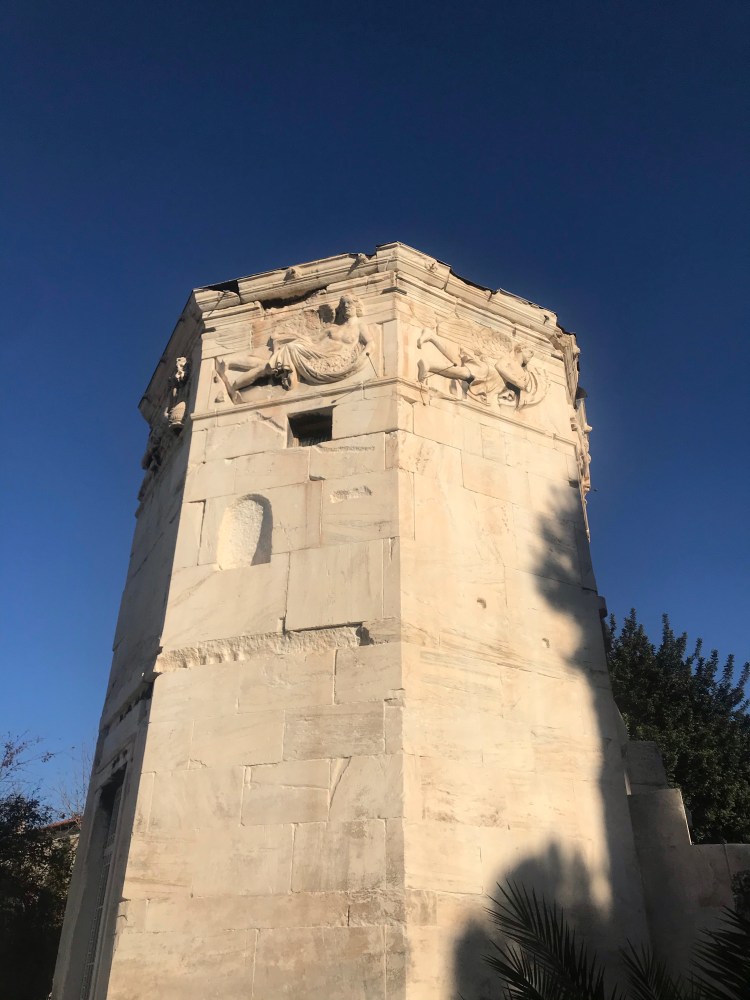
Photograph three interesting details of the Tower of the Winds. Write a short but detailed description of the different functions the building has served.
The building served as a wind vane on the top and also had a water clock that powered by a hydraulic mechanism that was inside the building. It was powered by water pressure which came from the south side of the monument. It also served as a church in the Byzantine period. It has christian content that dated to the 13th and 14th century that are still on the monument. During the late Ottoman occupation it also served as takke, which is a place used for retreats and spiritual gatherings of the Sufi brotherhood. It is now used as a monument after it was unearthed from being buried.
Hadrian’s Arch
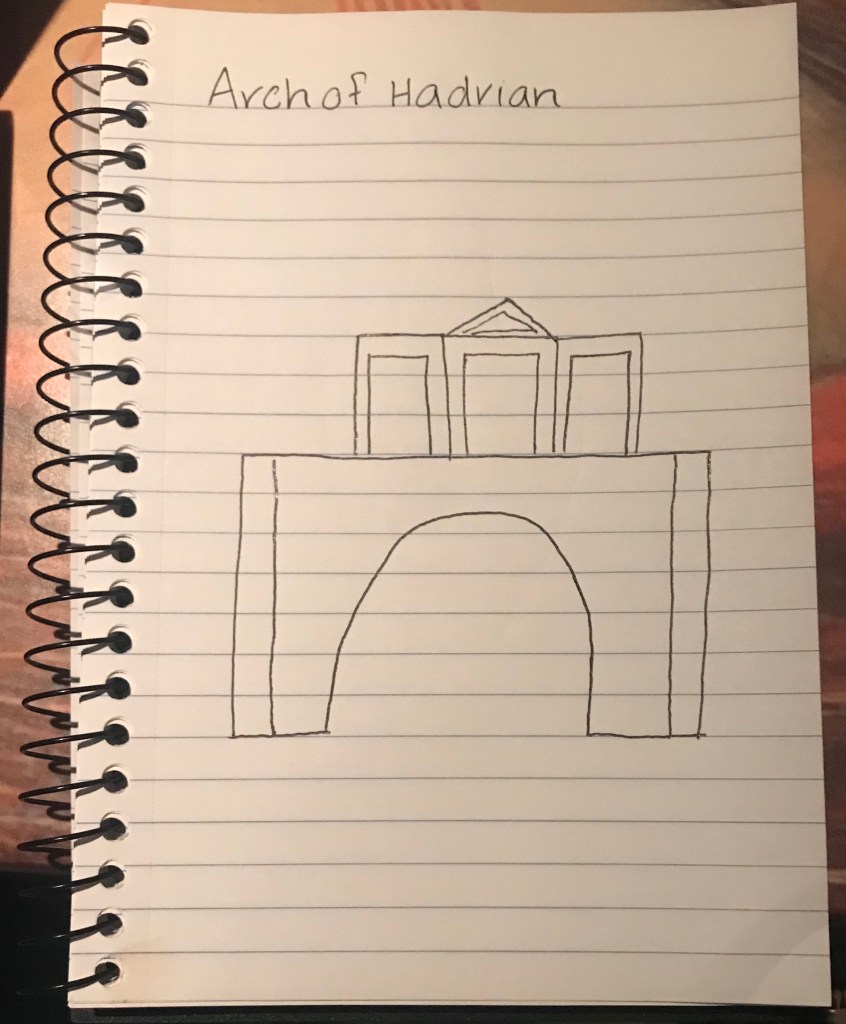
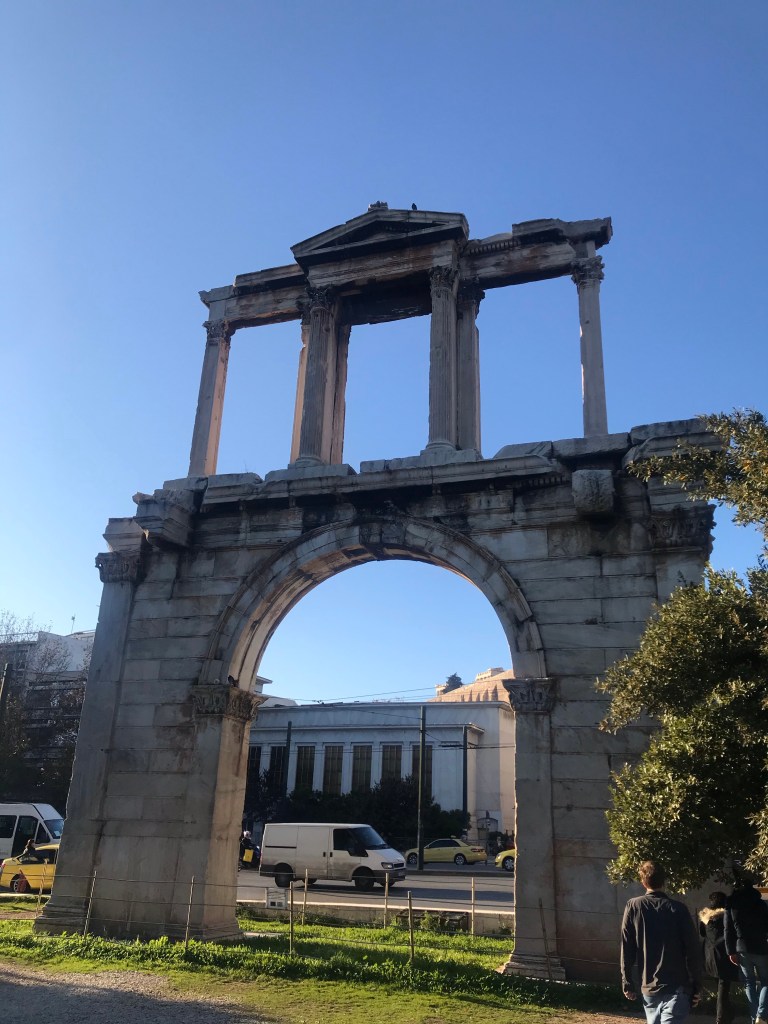
Draw and then describe in a long paragraph the Arch of Hadrian. Do you focus on different aspects of the Arch when you write about it than when you draw it?
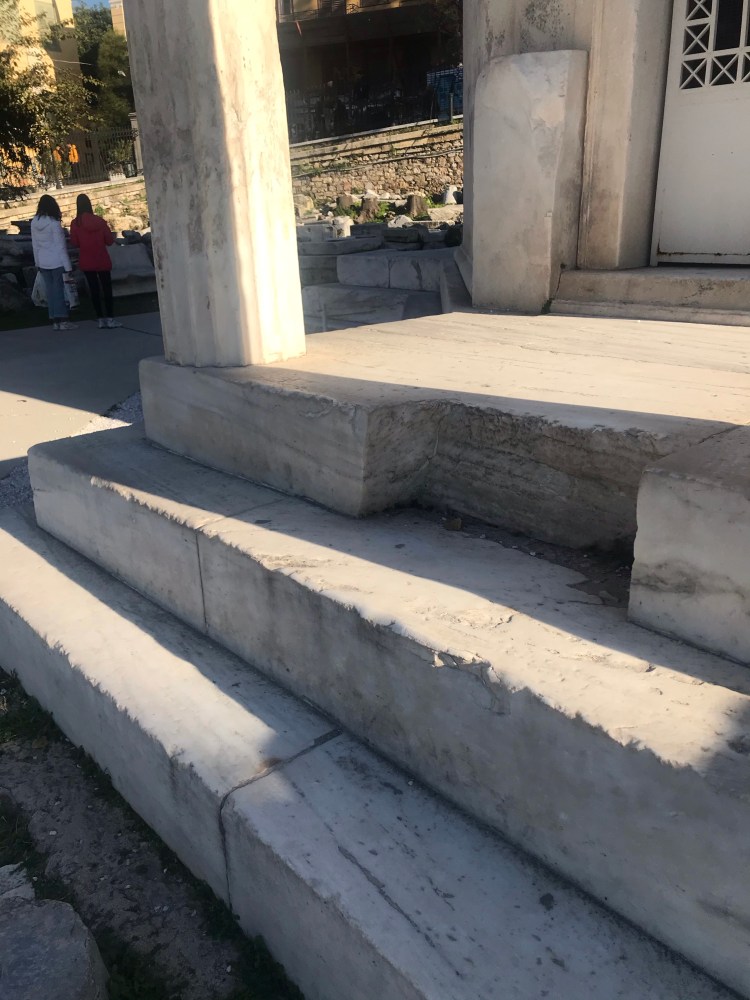
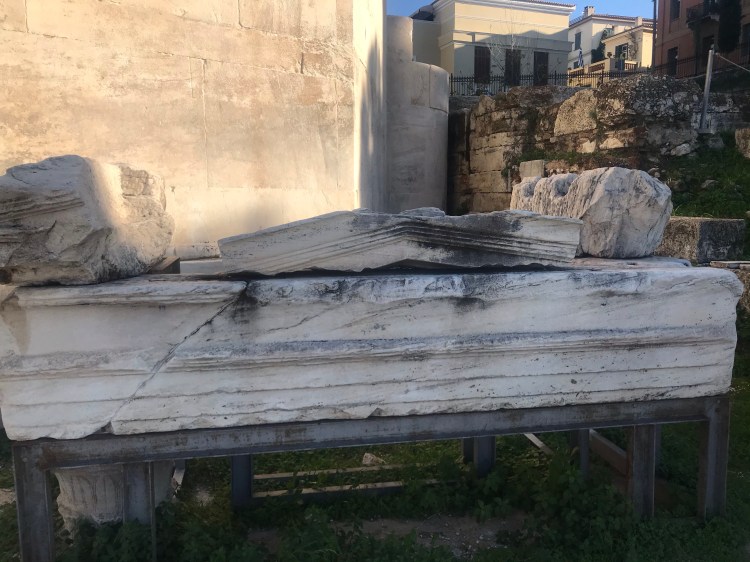
Hadrian’s Arch is surprisingly small. It has height because of the smaller skinnier structure that seems to basically be placed on top. It is a square structure with an arch in the middle. It is built with bricks and the two pillars on both sides. The pillars on the side are square and they In the arch, the bottom half is a pillar that has an capital at the top and the top of the arch is made of bricks. Like I said before on the top it has a skinnier structure that has three sections. On the top of the middle section it has a triangle frieze on the top. Each of the pillars on the top also have capital. It seems to be well preserved, but it still looks like it is missing something more around the top.
I noticed that when I was describing the arch I was more focused on the smaller details that had to do with the structure and architecture of the building. When I was drawing the arch I found myself focusing on the general structure and shape and not the finer details.
Kerameikos
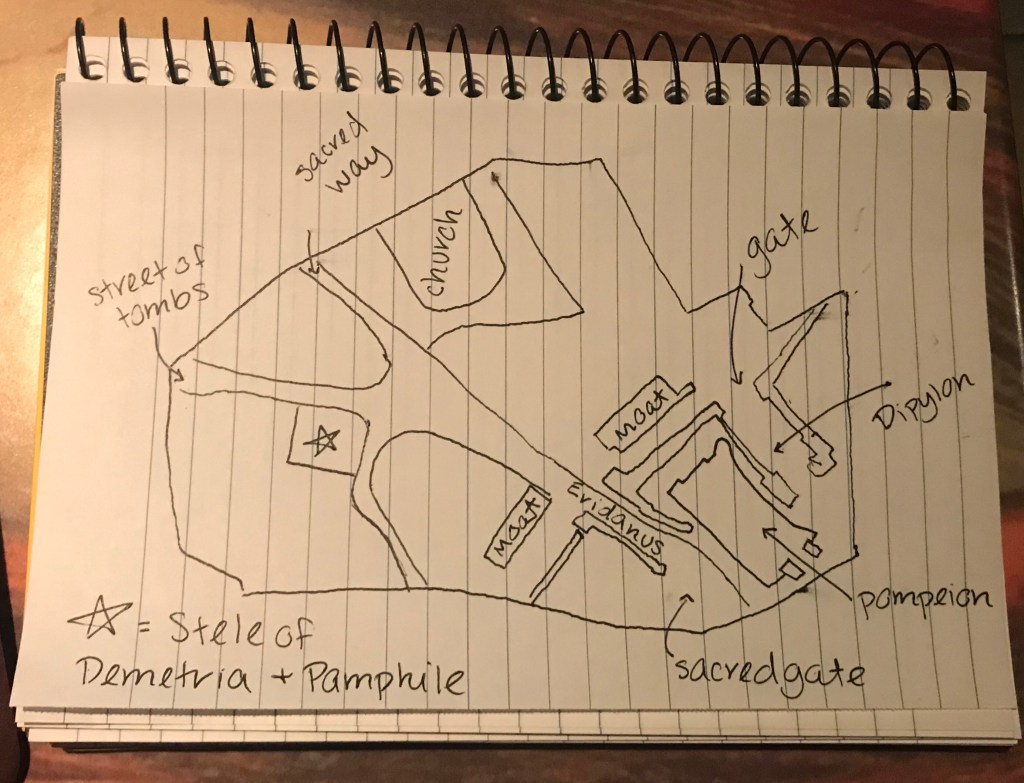
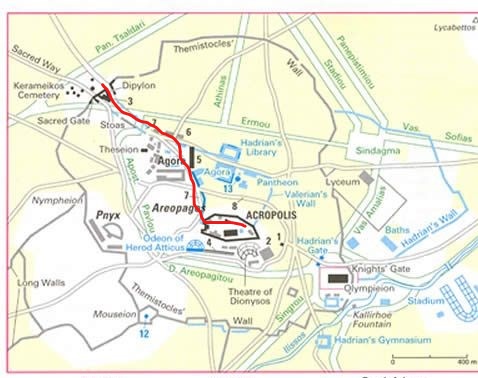
Draw a map of the Kerameikos district, paying particular attention to the roads and the gates into the city. Draw the route of the Panathenia procession to the Acropolis. Also mark where the Stele of Demetria and Pamphile was located. Make sure you visit the museum.
National Archaeological Museum:
Draw a picture of the so-called Dipylon Amphora. Photograph the picture and post it. Write a clear description of it as well. When was it made? Where was it discovered? What is on it? What purpose did it serve?
The Monumental Attic grave-amphora is from the Kerameikos cemetery. It was made around 750 BC. Depicted on it is a funeral and mourning seen. You can see the corpse being help up and you can see the people around the corpse with their hands on their head, probably pulling their hair as a usual mourning gesture. This was made as a grave marker.
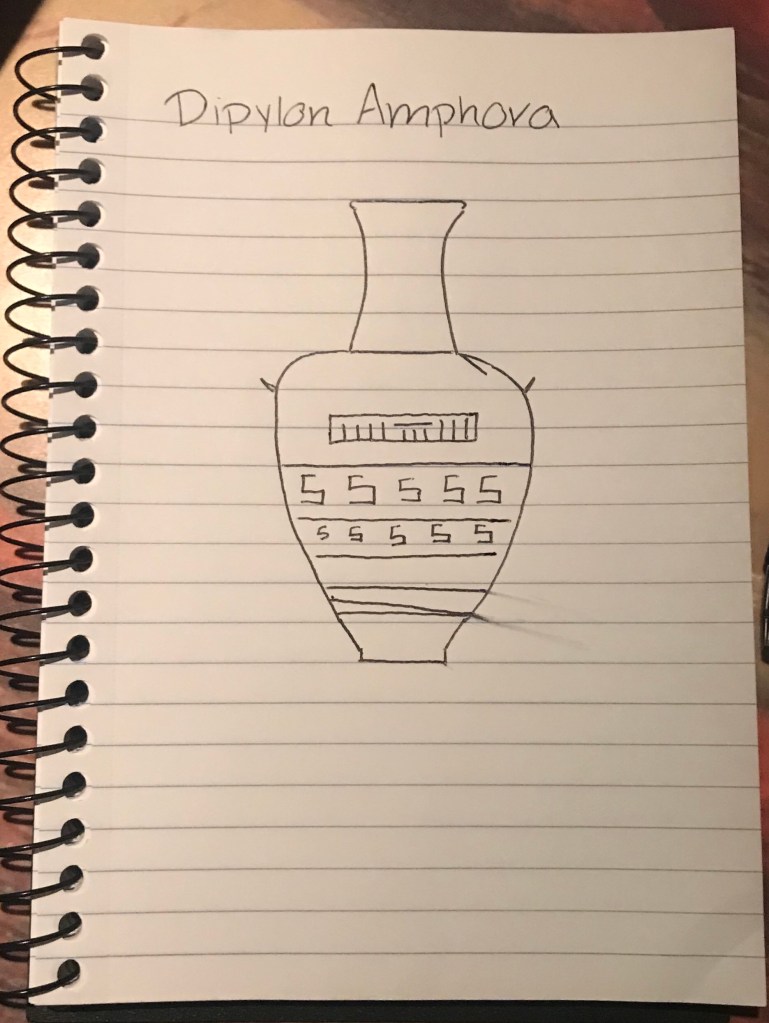
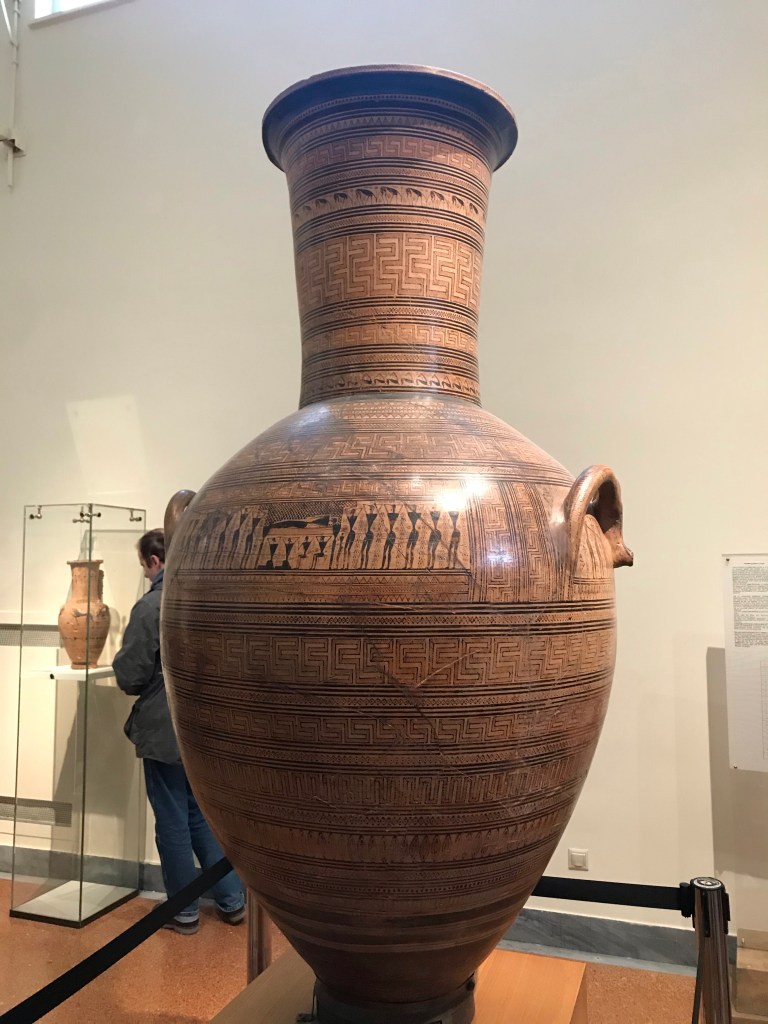
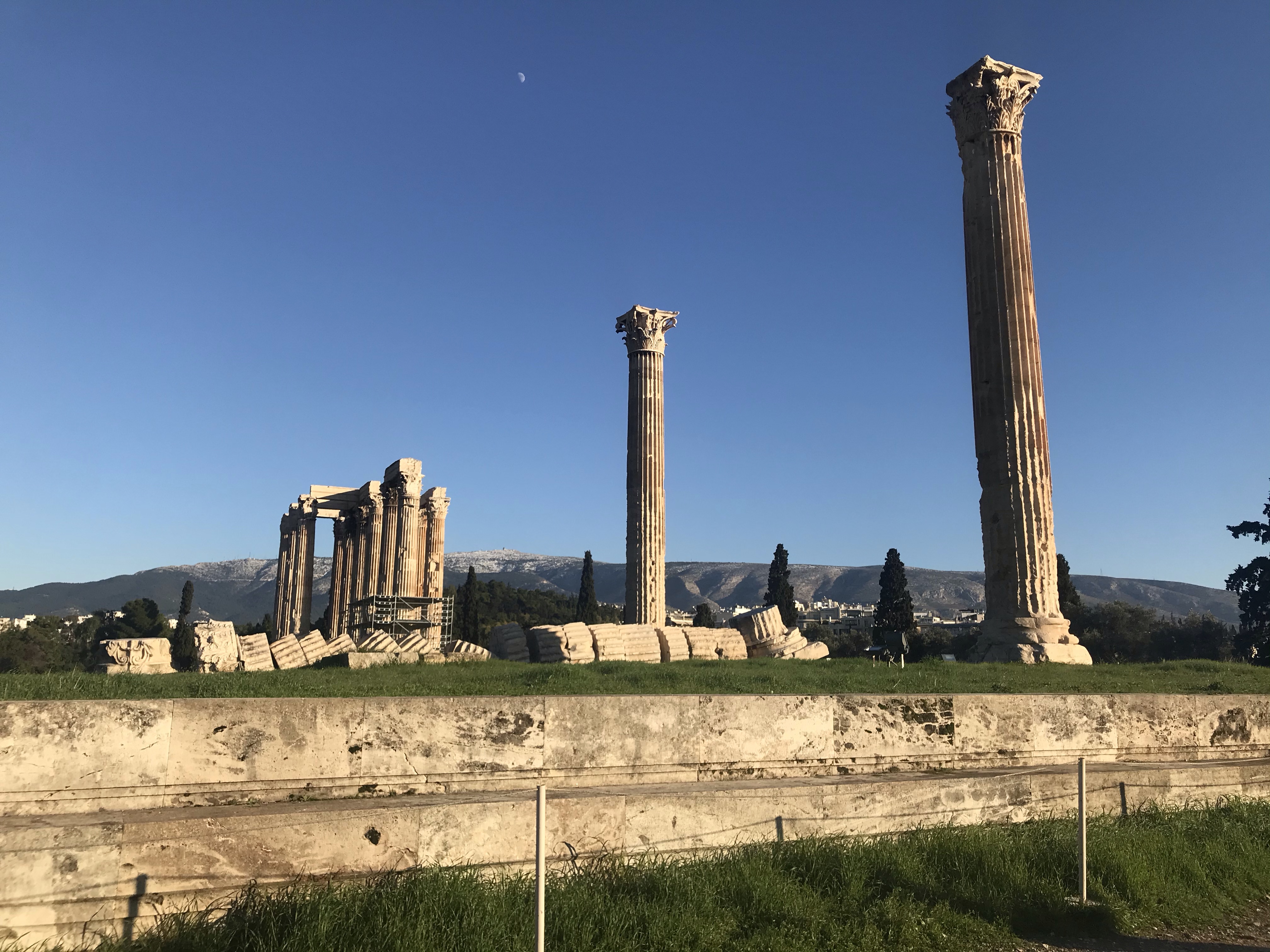
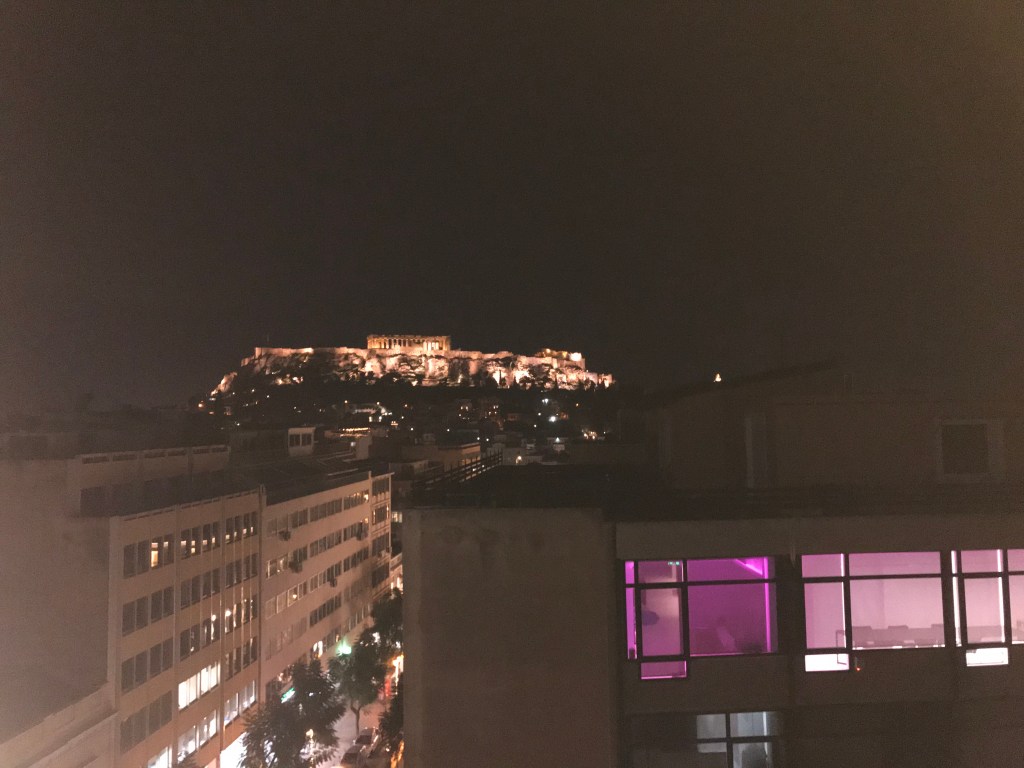
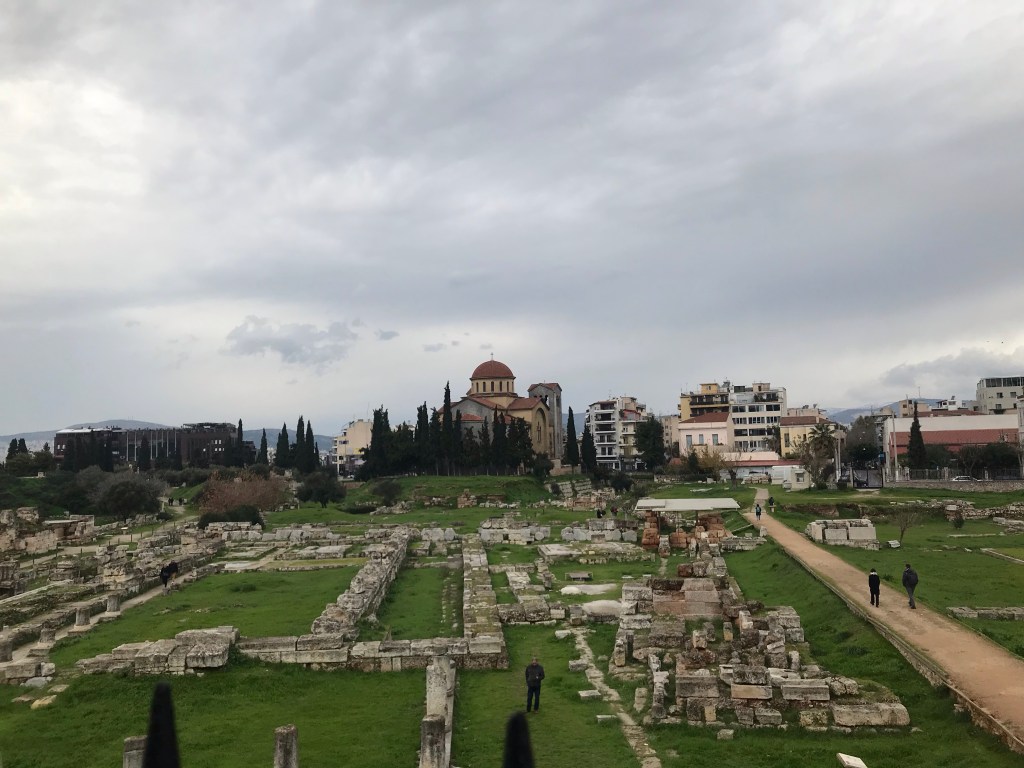
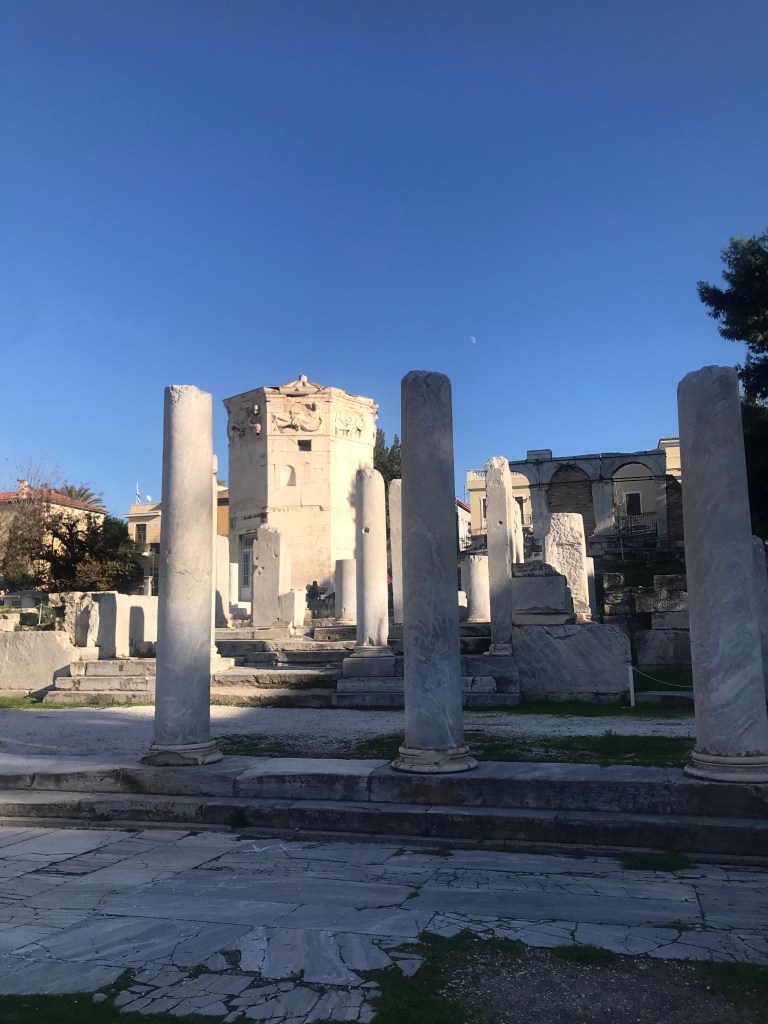
I know I’ve only been here for about three days, but I am completely in love with this city. The food, the people, and the culture is so amazing. Here are just a few picture of what I’ve seen so far.
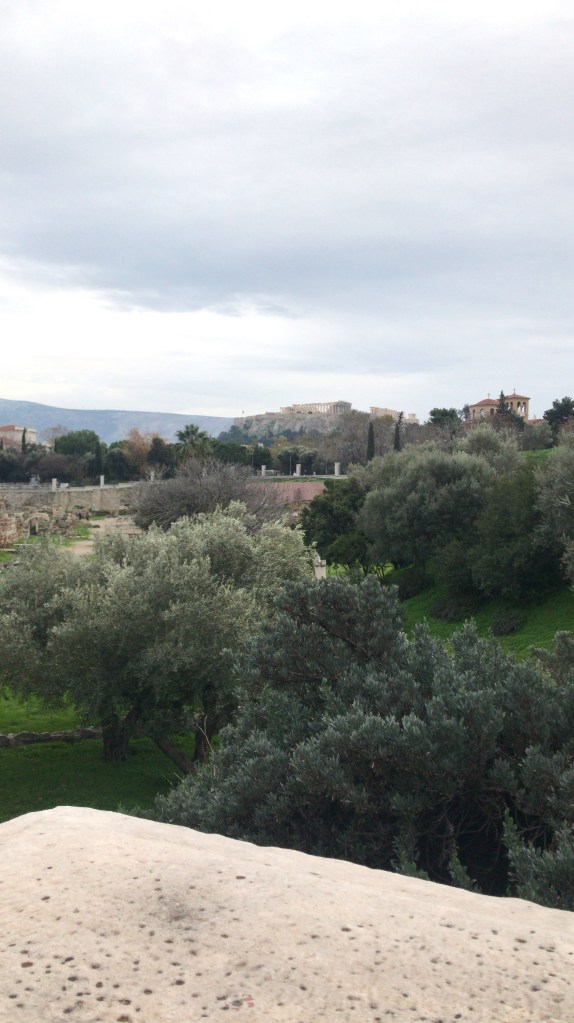
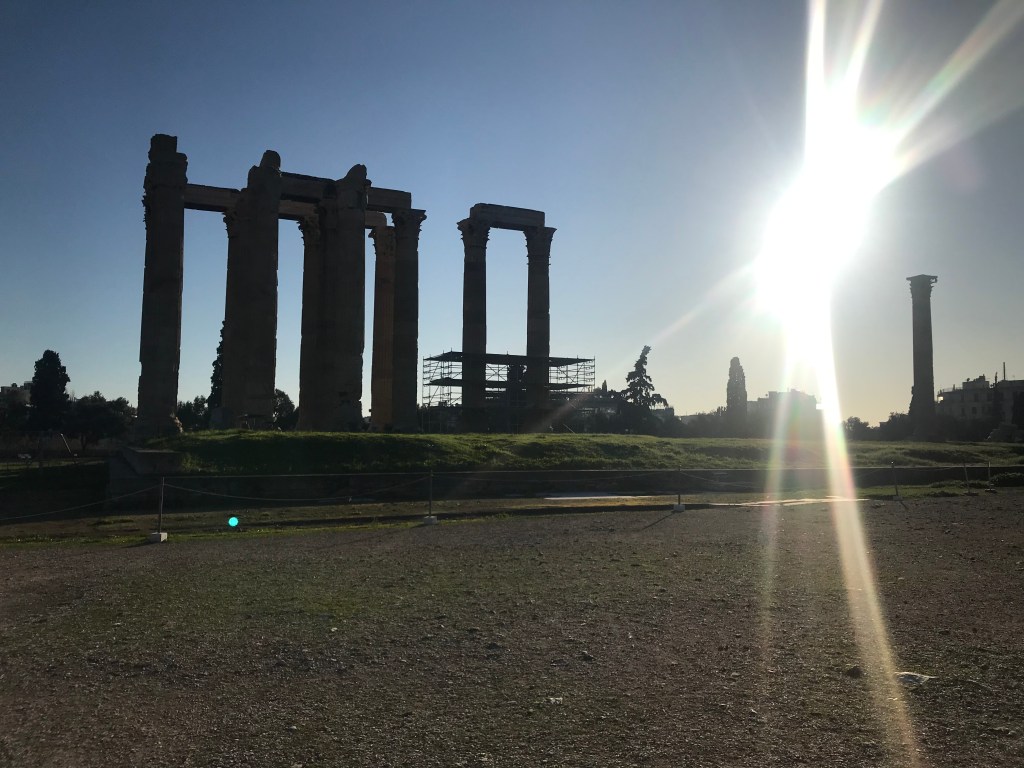
Steven Johnston, American Dionysia
1. Does Johnston argue that democracy makes people satisfied? What does he have to say about that?
Johnston argues that democracy rarely leaves people satisfied and that it seems to cause more problems then solutions. It can cause a lot of resentment from people because it s not seem to deliver on its promises. Johnston also argues that democracy is linked it violence and death. PG 1.
2. How was Oedipus a success according to Johnston?
Oedipus was a success because of the ambiguous nature of his past actions. PG 20.
3. In what direction does Springsteen’s character in Easy Money push Rousseau?
Springsteen wants to push Rousseau beyond the political and into the economic. PG 146.
4. Compare the Acropolis museum to Johnston’s account of 9/11 Memorial.
How does it differ from Pericles funeral oration?
The Acropolis museum much like the 9/11 Memorial is also built on top of the ruins of what was there before. The Acropolis museum is built over excavations and the 9/11 Memorial is built exactly where the Twin Towers used to be. Johnston focuses a lot of the death and grieving. He argues that the grieving for the events that happened at 9/11 are a little misconstrued and very circular. The Acropolis museum also talks a lot about funerals and a lot of the pieces they have are depicting funerals. It also focuses a lot on the pieces that are missing in the Acropolis either because they are in Britain or because of the fall of the Acropolis.
Pericles funeral oration is very much focused on the future of the city and does not focus so much on the death of the city. While, according to Johnson’s account, the speeches from President’s Bill Clinton and George Bush focused very much on the deaths of this tragic event and not the future.
Joan Connelly, The Parthenon Enigma
5. Who was taken up the Acropolis in a chariot driven by a woman dressed as Athena. He also significantly contributed to the planning of the Agora.
Peisistratos. PG 61.
6. Where was the ‘ancient image’ (olive wood ‘statue’ of Athena) stored? Where did is reportedly come from? What kind of image was it?
This ancient image is in the Old Athena Temple. It was believed to have fallen from the Heavens in the early days of Athens. It is not of her human shape, but it is a simple olive wood tree trunk. It was not regarded as Athena herself, but it is her essence. PG 68.
7. What does she argue is memorialized in the frieze of the Parthenon?
Connelly argues that what we are seeing on the frieze of the Parthenon is actually the preparation of a sacrifice of one of the daughters of Erectheus.
Freud, “A Disturbance of Memory on the Acropolis.”
8. What does Freud say has been the aim of his ‘scientific work’ in a Disturbance of Memory?
Freud says that the aim of his scientific work was to shine light on unusual behaviors of the mind and to indicate where those might come from. PG 239.
9. What experience of Freud have upon seeing the Acropolis of Athens?
Fred claims that he thought t himself that the place actually exists like he learned in school. PG 241.
10. What explains his behavior in Trieste?
Freud claims the his behavior in Trieste is explained by someone’s inability to believe something that seems to good to be true, like winning a prize. This could also be caused by someone’s refusal to be happy. People do not think they are worth the happiness that this has brought into their life. PG 242.
11. Two general characteristics of the phenomena of derealization:
The first characteristic is that it is trying to keep something away from the ego. The second is that they rely on your memories and past situations which were distressing. PG 245-6.
12. What does Freud conclude interfered with he and his brother’s enjoyment of the journey to Athens?
Freud concludes that it is this feeling of guilt that they had in Trieste that began to interfere with their enjoyment of the trip. PG 247.
Steven Johnston, American Dionysia
1. What would it mean for the American Veterans Disabled for Life Memorial to mitigate its inscriptions for Steven Johnston?
To mitigate the inscriptions on the American Veterans Disabled for Life Memorial is a failure of democracy to Johnston. He argues that democracy should make up for its deficiencies in its memorials, and to lessen the gravity of the sacrifices in this memorial would be to do just that.
2. Importance of the realization that soldiers often die for nothing; what work should that knowledge perform?
The realization that soldiers often die for nothing would serve as knowledge that we can recognize that we forced our soldiers to commit crimes. It would point to the criminal nature of war. This knowledge should also encourage anger from citizens when their country goes to war. This would in a way work to expose democracy. PG 88.
3. What does Johnston say about the position of the enemy in memory and memorials? How does Johnston suggest we should treat our enemies?
Johnston says that we should be able to include the enemy into the memorial either by having them design the memorial or by having their perspective incorporated in the memorial. We should use them to create a world where their ideology no longer exists. PG 27.
4. Does Johnston advocate tragic or triumphant orientations to memorials and public memory?
Johnston advocated for tragic orientations to memorials and public memories. He encourages what he calls ‘tragic patriotism’ discouraging ‘patriotic democracy’s’ need for tributes that recognize a countries greatness and ignite feelings of pride. He argues that this can also encourage people to forget the costs of the achievements that are commemorated. Most importantly he encourages something that he calls Admissions Day where democracy would stop and it is used to recognize the damage that democracy might have on its citizens. PG 83.
Read Joan Connelly, The Parthenon Enigma pages 1- 125 before we arrive in Athens.
5. Who proclaimed in the 18th century that the peak of Greek art coincided with their democratic form of government?
Johann Winckelmann. PG xi
6. Who banned all polytheistic statuary?
Roman emperor Theodosios I. PG xvi
7. Who was enthroned on the Acropolis and dedicated a reconstruction of the Parthenon? What would be removed?
King Otto was enthroned on the Acropolis. It was Leo von Klenze who advocated for the restoration saying that “all the remains of barbarity will be removed.” The king then obliged to this and allowed it to happen. PG. xi
Questions answered with lecture by Joan Connolly. https://youtu.be/76pNYG-BXcY
What did the Athenians do with the pieces of the old Parthenon?
They left it as a smoking ruin. They were concerned that if they cleaned it up nobody would remember or believe that it happened. When they cleaned they up they made it into a memorial display making sure nobody would forget.
What are the two rivers of Athens?
The Kephisos and Eridanos rivers.
What Greek word does she use that means ’the girls’ or ’the virgins’?
Parthenon
Another religious building, according to Connolly, that has a symbol of sacrifice over the door?
Christian Churches and at the Temple of Zeus at Olympia.
Caneva, G., A. Pacini, L. Celesti Grapow, and S. Ceschin. 2003. “The Colosseum’s Use and State of Abandonment as Analysed through Its Flora.” International Biodeterioration & Biodegradation 51(3): 211–19.
The authors of this article analyze the different species that have emerged in the Colosseum and how the abandonment and the mistreatment of the monument may have contributed to the increase of certain types of species. The abandonment of the monument, and the different ways that people used it during this time, contributed to the different plant species that have emerged there today. The authors also show evidence that the changes in the surrounding urban parks also contributed to changes in the species seen at the Colosseum. In my final project I will use this to explain how Rome has been changing around this grand monument and talk about the urban developments that have occurred around it.
Elkins, Nathan T. 2014. “The Procession and Placement of Imperial Cult Images in the Colosseum.” Papers of the British School at Rome; London. http://search.proquest.com/docview/1566755205/abstract/ED82CBD0AAB0460EPQ/1 (December 21, 2019).
The author examines the importance of the worship of emperors and the Gods in Rome at the time that the Colosseum was built. First the author goes through ana analyzes the importance of emperor worship through coins and most theatres the Rome talking about hoe they would set up thrones for the Gods and the emperors. The importance of these in the Colosseum is how this worship was tied by the huge project that was building the Colosseum. The author claims that Roman politics has always been between god and worshipper. In my final film project I plan to try and find these thrones I they are still in the Colosseum and analyze the importance of emperors in Roman politics.
Feldman, Louis H. 2001. “Financing the Colosseum.” Biblical Archaeology Review; Washington 27(4): 20-31+.
This author tries to explain how the Colosseum was financed and if Titus and Vespasian financed it themselves. While there is no clear answer on who actually financed the building of the Colosseum, there is evidence in inscriptions on the structure that both Vespasian and Titus wanted their names to be commemorated on the monument. Not only did they want their names commemorated, but they also wanted their military achievements on there for everyone to remember. I learned about this inscription and how researchers have translated it. This is a political strategy by the two to give them credit for what they knew was going to be an important symbol for Italian culture. I plan to use this in my final project has background on how Titus and Vespasian wanted their political achievements commemorated.
Follain, John. 2013. “IT WON’T BE REBUILT IN A DAY: They’ve Got the Builders in at the Colosseum in Rome. Yet the Pounds 21m Project Is Being Controversially Financed by a Fashion Tycoon. Has Italy’s Glorious Heritage Been Hijacked for Profit?” Sunday Times; London (UK): 22.
The author of this article interviews Diego Della Valle about how he has donated to the project to reconstruct the Colosseum. The author is quite critical of Della Valle and the reasons why he has donated so much money claiming that it is all to advertise his own companies. Della Valle pushes back on these accusations and references his Italian culture as the reason to why he wants to donate to the Colosseum, because it is a symbol of Italy. I plan to use this in my final project to talk about how the Colosseum does represent Italian culture and talk about what kind of shady transactions might have happened to finance the restoration of the monument.
Gardner, James. 2010. “Leisure & Arts — Masterpiece: A Wonder From Any Angle — The Colosseum Is a Lasting Monument to Rome Itself.” Wall Street Journal, Eastern edition; New York, N.Y.: W.10.
The author talks about the beauty of the Colosseum and what it means to Rome. I learned from this very visual article that the Colosseum was built on top of a lake and statue that a previous emperor had built for himself. For my final project I plan to use this and talk about how the Colosseum was built for a very basic purpose and use but has now become a political symbol to the world.
Mueller, Tom. 2011. “Unearthing the Colosseum’s Secrets.” Smithsonian; Washington 41(9): 26–35.
This author talks about how he went to the Colosseum and got to analyze the undergrounds or the hypogeum of the structure. I learned they mainly used the hypogeum to transport the animals for the rituals and ceremonies that were performed in the Colosseum. Much of the hypogeum has been mapped out and they can tell what changes were caused because of natural causes. In my final project I plan to use this to talk about the extent of the building of the Colosseum.
“The Colosseum.” 1884. Scientific American 50(23): 361–361.
This author here highlights the importance of the Colosseum and the ceremonies that happened in the theatre. The author explains how slowly the gladiator fights were ceased and how then eventually the Colosseum had stopped being used and the materials were taken. The author also explains how certain doors were used for emperors. In conclusion the author briefly mentions how although thee structure is grand and the building has been admired as great, there is no architect who has been accredited for the structure. I plan to use this in my final project to highlight the importance of the emperors and the legacy that they would leave with this monument.
“The Destruction of the Colosseum.” 1896. Scientific American 75(19): 344–344.
The author here talks about how the Colosseum might collapse. The author alludes to how the structure was meant to last forever but the idea of the monument collapsing is not out of line. The author also talks about how easily plants took root to the building when it wasn’t being used. In my final project I plan to use this to allude to how the monument could collapse and what the ramifications for that might be.
Thorpe, Stephen. 2003. “The Colosseum and Trajan’s Market, Rome.” Access by Design (95): 14–17.
The author talks about how the Colosseum has changed since its building and how there have been efforts to modernize the monument. The author mainly focuses on the building of lifts so that more of the public can access the upper levels of the monument. The author also briefly alludes to the safety risks of allowing more people to access the monument in more ways. The author mainly focuses on how there were lifts originally in the Colosseum to lift animals and equipment. In my final project I plan to use this as evidence that they are trying to modernize the monument while still trying to keep some of its original elements that make it such an important attraction.
Wilkinson, Tracy. 2006. “COLUMN ONE; Rome’s Falling Arches; The Colosseum and Other Treasures of the Archeologically Rich City Need More Funding and Less Abuse, or They May Soon Be History.: [HOME EDITION].” Los Angeles Times; Los Angeles, Calif.: A.1.
The author talks about and explains the harms that tourism has on the Colosseum. The author explains how they should have more limitations on the building and the number of tourists that they let in on a daily basis. The article talks about projects that the government had to try and rebuild and protect the monument. I plan to use this article to talk about the importance of this monument to Italy and how it has changed.
In American Dionysia, Steven Johnston argues that democracy and violence can never be apart. He argues that violence lives within democracy, and democracy can only kill itself and violence goes hand in hand with that. Johnston also argues that we are living in democratic times, which means we must be living in violent time. I argue that we are not living in wholly democratic times, which in turn means that the violence being perpetrated at the moment is not violence in connection with democracy, but it is violence to control the lack of democracy. This creates a very clear distinction with violence that is in connection with our democracy and violence that is in control of our democracy.
I believe that Johnston does a great job unraveling the idea that violence is inherently in connection with the idea of democracy, this is the only way that he can see violence in our society. And he is also assuming a complete and trustworthy democracy in our institutions. Now the idea that there is also violence in our society to control democracy does not attack the idea of democracy itself, because this interpretation suggests that violence to control undemocratic aspects is pushing you toward more democracy.
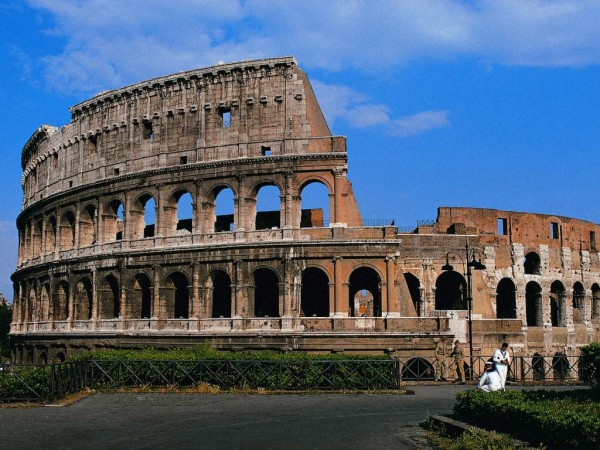
The monument that I am most excited to see in Rome is the Colosseum. The Colosseum was built as a gift to the citizens by the Emperor Vespasian, and to have a lasting monument of his power in Rome. It was neglected for four centuries and the materials were used as building materials for other projects. There has now been vast efforts to preserve the Colosseum and it has become a main attraction in Rome.
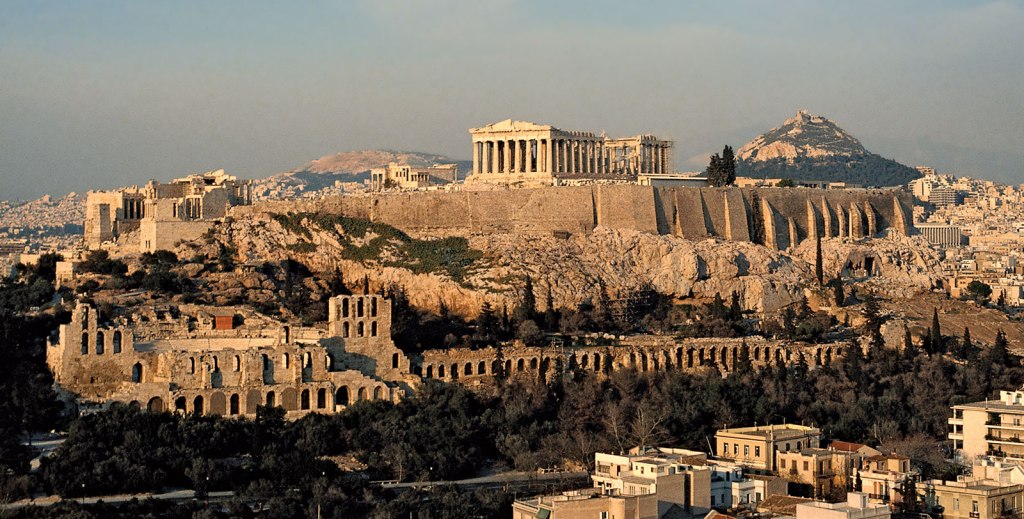
“Nobody can discover the world for somebody else. Only when we discover it for ourselves does it become common ground and a common bond and we cease to be alone.”
— Wendell Berry.
I am very excited to get the opportunity to study abroad in Athens and Rome in January. I will be using this blog mainly to academic assignments, but I will also be using it to upload pictures from my travels.
I am very excited to be blogging my experience as I study monumental politics in DC, Athens, and Rome. I hope that by following this blog you can get an inside look at what I will be studying and of my overall experience abroad.

 Keep up with Veronica abroad